24/7 Space News
SPACEWAR
Small satellite mission targets maritime activity monitoring from orbit
illustration only

Small satellite mission targets maritime activity monitoring from orbit

by Robert Schreiber
Berlin, Germany (SPX) Dec 03, 2025

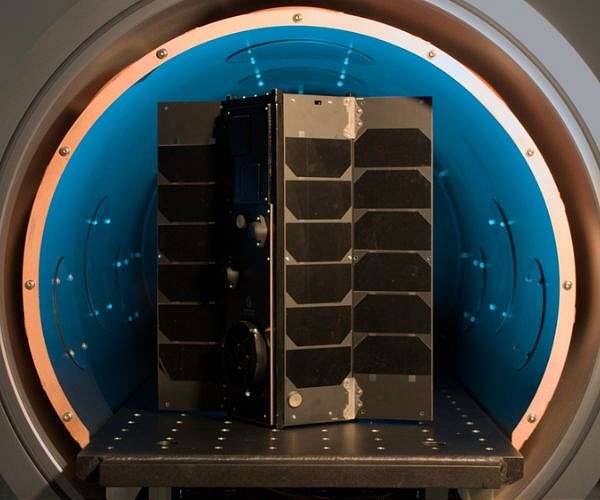
The OTTER Optical Traffic Tracking Experiment for Responsive Space satellite has entered service in orbit to support maritime monitoring following its launch on 28 November 2025 into an orbit at about 500 kilometres altitude. The nanosatellite has a mass of roughly six kilograms, is comparable in size to a shoebox and deployed its solar panels and instruments after separation from the launcher. The German Aerospace Center DLR leads the OTTER mission with industry partners as an experimental effort to determine how small satellites can help deliver space based capabilities more quickly and supplement existing maritime reconnaissance systems.

OTTER uses one antenna to receive position signals from ships while its onboard camera acquires images to verify the reported locations. Additional antennas, receivers and reflectors enable detection of illegal fishing, ships in distress, oil pollution and suspected manipulation of signals on the high seas. The mission will operate for about two years in low Earth orbit before the satellite re enters Earths atmosphere, with an electric propulsion system available to hasten its controlled destructive re entry.

Satellites in orbit can build situational pictures of maritime activity across ocean regions that are not limited by national borders, which differentiates them from land or sea based systems. Alongside large dedicated satellites, operators now employ growing numbers of commercial small satellites to extend coverage and improve resilience because multiple smaller spacecraft can be replaced more easily if a unit fails.

DLRs Responsive Space Cluster Competence Center RSC3 in Trauen, Lower Saxony, manages the OTTER mission and conducts research on responsive space concepts for maritime applications. Responsive space in this context refers to the ability to provide satellite services at short notice, such as expanding infrastructure, replacing failed satellites or deploying new capabilities. The RSC3, founded five years ago with support from Germanys Federal Ministry of Defence, coordinates research, users and industry to develop these capabilities.

The OTTER spacecraft is a three unit 3U CubeSat that SpaceX launched from the United States. Over its planned two year mission, it will downlink data from ships Automatic Identification System AIS together with camera imagery to a ground station, where teams process and evaluate the information. Through the same ground segment, controllers upload new instructions and observation schedules to adjust operations as needs change.

Spacecraft with masses below 500 kilograms are classified as small satellites or SmallSats. At about six kilograms, OTTER falls into the nanosatellite class, defined for satellites up to ten kilograms, and serves as a testbed for methods to design, build and operate such systems for monitoring marine activities from orbit.

Related Links
German Aerospace Center (DLR)
Military Space News at SpaceWar.com

Subscribe Free To Our Daily Newsletters
Tweet

RELATED CONTENT
The following news reports may link to other Space Media Network websites.
SPACEWAR
ICEYE boosts SAR capacity with launch of five satellites for commercial and national missions
Los Angeles CA (SPX) Nov 28, 2025
ICEYE has placed five new Synthetic Aperture Radar (SAR) satellites into orbit, extending its commercial constellation and adding spacecraft for several national customers. The satellites rode to space on SpaceX's Transporter-15 rideshare mission launched on November 26, 2025, from Vandenberg Space Force Base in California, after integration by Exolaunch. Each spacecraft has established communication with ground controllers, and routine commissioning operations are underway. The new satellites wil ... read more

SPACEWAR
NASA extends ISS National Lab management contract through 2030

Micro nano robots aim to cut carbon buildup in closed life support systems

Space station reaches new record with all docking ports in use

Trump NASA nominee aims to beat China in new Moon race

SPACEWAR
Space shuttle design study maps path to breakthrough inventions

UK plasma thruster test positions Pulsar Fusion for larger satellite propulsion

How Cloud Render Farms Are Powering the Next Generation of Space Visualization and Simulation Workflows

LandSpace reviews booster loss after Zhuque-3 reusable rocket test

SPACEWAR
Martian butterfly crater reveals low angle impact and buried lava history

Chinese team runs long term Martian dust cycle simulation with GoMars model

Scientists trace ancient mega watersheds on Mars

NASA rover hears electric crackles inside Mars dust devils

SPACEWAR
China supports private space firms to expand global reach

Wenchang spaceport hits record cadence with double-digit launches in 2025

China consolidates new commercial space regulator and industry roadmap

Beijing space lab targets orbital data centers for AI era

SPACEWAR
Satellite surge threatens space telescopes, astronomers warn

MDA Space plans C250 million senior unsecured note issue maturing 2030

Applied Aerospace and PCX create US flight and space hardware group

EIB launches Space TechEU finance program for European space sector

SPACEWAR
Roadmap sets circular economy agenda for space hardware and debris mitigation

Social Media Audits as a Tool for Stronger Professional Marketing Strategies

Greece deploys first national ICEYE radar satellites for disaster monitoring

X-MAT introduces X-FOAM: A game-changing ceramic foam for extreme environments

SPACEWAR
Supernova mixing traced as source of key life elements

SwRI opens NOUR lab to track chemical pathways from nebulae to planetary systems

TRAPPIST 1 flares mapped to probe planetary habitability

Gels may have given early Earth chemistry a place to organize into life

SPACEWAR
SwRI links Uranus radiation belt mystery to solar storm driven waves

Looking inside icy moons

Saturn moon mission planning shifts to flower constellation theory

Could these wacky warm Jupiters help astronomers solve the planet formation puzzle?

Subscribe Free To Our Daily Newsletters


The content herein, unless otherwise known to be public domain, are Copyright 1995-2024 - Space Media Network. All websites are published in Australia and are solely subject to Australian law and governed by Fair Use principals for news reporting and research purposes. AFP, UPI and IANS news wire stories are copyright Agence France-Presse, United Press International and Indo-Asia News Service. ESA news reports are copyright European Space Agency. All NASA sourced material is public domain. Additional copyrights may apply in whole or part to other bona fide parties. All articles labeled "by Staff Writers" include reports supplied to Space Media Network by industry news wires, PR agencies, corporate press officers and the like. Such articles are individually curated and edited by Space Media Network staff on the basis of the report's information value to our industry and professional readership. Advertising does not imply endorsement, agreement or approval of any opinions, statements or information provided by Space Media Network on any Web page published or hosted by Space Media Network. General Data Protection Regulation (GDPR) Statement Our advertisers use various cookies and the like to deliver the best ad banner available at one time. All network advertising suppliers have GDPR policies (Legitimate Interest) that conform with EU regulations for data collection. By using our websites you consent to cookie based advertising. If you do not agree with this then you must stop using the websites from May 25, 2018. Privacy Statement. Additional information can be found here at About Us.