24/7 Space News
MARSDAILY
Scientists trace ancient mega watersheds on Mars
illustration only

Scientists trace ancient mega watersheds on Mars

by Clarence Oxford
Los Angeles CA (SPX) Dec 03, 2025

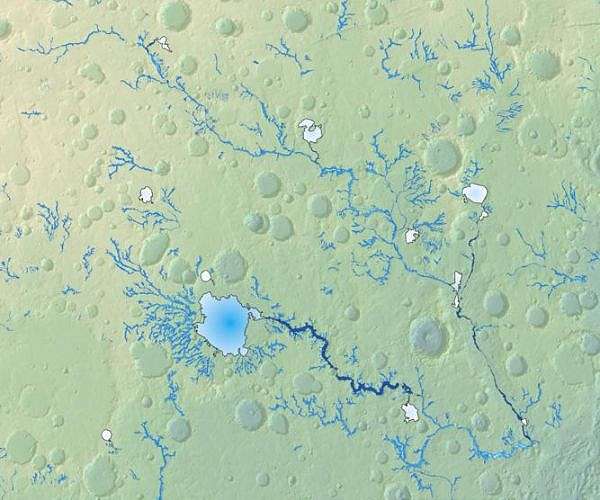
Billions of years ago, rainfall on Mars fed rivers that cut valleys, overtopped crater rims and carved canyons, with some flows likely reaching a northern ocean basin on the planet.

Researchers at The University of Texas at Austin have now organized these fluvial features into large drainage systems, producing the first global inventory of major Martian river basins and identifying 16 large-scale river systems where long-lived surface water would have been most likely to support habitable conditions.

Co-author Timothy A. Goudge, an assistant professor in the UT Jackson School of Geosciences Department of Earth and Planetary Sciences, noted that scientists have recognized Martian rivers for years but had not previously quantified how extensively they formed connected drainage networks at the planetary scale. Postdoctoral fellow Abdallah S. Zaki and Goudge combined earlier global datasets of valley networks, lakes, rivers, canyons and sediment deposits, then traced the contributing areas to delineate entire drainage systems and determine their size.

From this synthesis, the team identified 19 major clusters of fluvial features, 16 of which form connected watersheds with drainage areas of at least 100,000 square kilometers, a threshold commonly used on Earth to define large basins. Zaki, who led the work, explained that they applied a simple mapping approach, linking previously cataloged features into coherent catchments.

On Earth, there are 91 large watersheds meeting or exceeding 100,000 square kilometers, including the Amazon River basin at about 6.2 million square kilometers and Texas' Colorado River basin at roughly 103,300 square kilometers, just above the large-basin cutoff. Large drainage systems on Earth efficiently move nutrients through river networks, which supports ecosystems with high biological diversity and, in cases such as the Indus River basin, has coincided with early centers of human civilization.

The researchers point out that Mars, which lacks plate tectonics, shows far fewer large drainage systems than Earth, where tectonic uplift builds mountains and varied topography that promote extensive, interconnected river networks. Even so, they calculate that large Martian drainage systems occupy only about 5% of the mapped ancient surface yet account for roughly 42% of the total sediment volume eroded by rivers.

Because river-transported sediment stores nutrients and preserves evidence of water - rock interactions, Zaki argues that these large basins are prime locations for future searches for signs of past life, provided scientists can locate where the eroded material was ultimately deposited. He noted that longer flow paths increase opportunities for chemical reactions between water and rock, which could enhance the likelihood that any biosignatures would be recorded in the sedimentary record.

Outside the large systems, most of Mars is covered by what the team describes as a mosaic of smaller drainage basins, each of which may once have hosted localized habitable environments. However, the 16 mapped large watersheds integrate long-duration fluvial activity and sediment transport and are therefore highlighted as efficient starting points for future mission planning focused on habitability.

Goudge emphasized that defining these large drainage systems provides a framework for choosing high-priority landing sites and orbital survey targets when designing missions to search for evidence of past life on Mars. Jackson School Department Chair Danny Stockli described the work, which also includes co-author and professor David Mohrig, as advancing understanding of Martian surface evolution and ancient hydrologic processes.

Research Report:Large drainage systems produced half of Mars' ancient river sediment

Related Links
University of Texas at Austin Jackson School of Geosciences
Mars News and Information at MarsDaily.com
Lunar Dreams and more

Subscribe Free To Our Daily Newsletters
Tweet

RELATED CONTENT
The following news reports may link to other Space Media Network websites.
MARSDAILY
NASA Orbiter Shines New Light on Long-Running Martian Mystery
Pasadena, Calif. (SPX) Nov 26, 2025
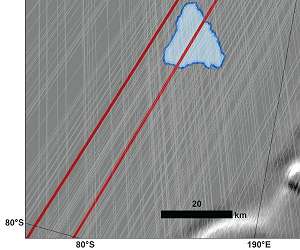
Results from an enhanced radar technique have demonstrated improvement to subsurface observations of Mars. NASA's Mars Reconnaissance Orbiter (MRO) has revisited and raised new questions about a mysterious feature buried beneath thousands of feet of ice at the Red Planet's south pole. In a recent study, researchers conclude from data obtained using an innovative radar technique that an area on Mars suspected of being an underground lake is more likely to be a layer of rock and dust. The 2018 ... read more

MARSDAILY
NASA extends ISS National Lab management contract through 2030

Micro nano robots aim to cut carbon buildup in closed life support systems

Space station reaches new record with all docking ports in use

Trump NASA nominee aims to beat China in new Moon race

MARSDAILY
Space shuttle design study maps path to breakthrough inventions

UK plasma thruster test positions Pulsar Fusion for larger satellite propulsion

How Cloud Render Farms Are Powering the Next Generation of Space Visualization and Simulation Workflows

LandSpace reviews booster loss after Zhuque-3 reusable rocket test

MARSDAILY
Martian butterfly crater reveals low angle impact and buried lava history

Chinese team runs long term Martian dust cycle simulation with GoMars model

Scientists trace ancient mega watersheds on Mars

NASA rover hears electric crackles inside Mars dust devils

MARSDAILY
China supports private space firms to expand global reach

Wenchang spaceport hits record cadence with double-digit launches in 2025

China consolidates new commercial space regulator and industry roadmap

Beijing space lab targets orbital data centers for AI era

MARSDAILY
Satellite surge threatens space telescopes, astronomers warn

MDA Space plans C250 million senior unsecured note issue maturing 2030

Applied Aerospace and PCX create US flight and space hardware group

EIB launches Space TechEU finance program for European space sector

MARSDAILY
Roadmap sets circular economy agenda for space hardware and debris mitigation

Social Media Audits as a Tool for Stronger Professional Marketing Strategies

Greece deploys first national ICEYE radar satellites for disaster monitoring

X-MAT introduces X-FOAM: A game-changing ceramic foam for extreme environments

MARSDAILY
Supernova mixing traced as source of key life elements

SwRI opens NOUR lab to track chemical pathways from nebulae to planetary systems

TRAPPIST 1 flares mapped to probe planetary habitability

Gels may have given early Earth chemistry a place to organize into life

MARSDAILY
SwRI links Uranus radiation belt mystery to solar storm driven waves

Looking inside icy moons

Saturn moon mission planning shifts to flower constellation theory

Could these wacky warm Jupiters help astronomers solve the planet formation puzzle?

Subscribe Free To Our Daily Newsletters


The content herein, unless otherwise known to be public domain, are Copyright 1995-2024 - Space Media Network. All websites are published in Australia and are solely subject to Australian law and governed by Fair Use principals for news reporting and research purposes. AFP, UPI and IANS news wire stories are copyright Agence France-Presse, United Press International and Indo-Asia News Service. ESA news reports are copyright European Space Agency. All NASA sourced material is public domain. Additional copyrights may apply in whole or part to other bona fide parties. All articles labeled "by Staff Writers" include reports supplied to Space Media Network by industry news wires, PR agencies, corporate press officers and the like. Such articles are individually curated and edited by Space Media Network staff on the basis of the report's information value to our industry and professional readership. Advertising does not imply endorsement, agreement or approval of any opinions, statements or information provided by Space Media Network on any Web page published or hosted by Space Media Network. General Data Protection Regulation (GDPR) Statement Our advertisers use various cookies and the like to deliver the best ad banner available at one time. All network advertising suppliers have GDPR policies (Legitimate Interest) that conform with EU regulations for data collection. By using our websites you consent to cookie based advertising. If you do not agree with this then you must stop using the websites from May 25, 2018. Privacy Statement. Additional information can be found here at About Us.