






AFP got a chance to take a look at what is inside.
- Concrete warehouse -
Data centers are the physical infrastructure that make our digital lives possible, yet most people have never seen one up close or understand how they operate.
Roughly 12,000 data centers are in operation in the world, with about half in the US, according to Cloudscene, a data center directory.
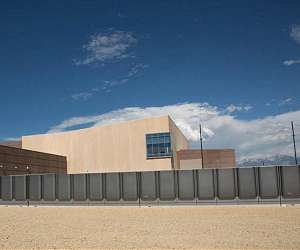
At its most basic, a data center is a concrete warehouse filled with thousands of computer servers working in tandem. Traditional facilities span one or two floors divided into vast rooms, though newer ones rise higher.
A facility may serve a single company or be shared by several clients.
The servers sit in standardized 19-inch (48 cm) racks -- essentially metal closets lined up in rows.
A large data center can house tens of thousands of servers running simultaneously, generating enormous heat and consuming significant energy for both power and cooling.
High-speed networking equipment -- switches, routers, and fiber optic cables -- connects everything, moving terabytes of data per second.
- Stay close -
Having a data center close to end users improves speed, which is critical for things like trading and gaming where immediacy is paramount.
Ashburn, Virginia, which has the highest concentration of data centers in the world, offers ideal conditions as it is located only about 30 miles from the US capital, Washington.
However, building in densely populated areas costs more and faces local resistance. Companies increasingly turn to rural locations where land is cheaper and zoning less restrictive.
But distance adds to loading times -- that brief delay when a page loads or a feed refreshes.
To balance cost and performance, operators typically house core infrastructure -- or the training of AI models -- in affordable rural regions while keeping equipment that handles time-sensitive requests closer to urban centers.
- Stay Cool -
Inside these bunker-like buildings, a single server rack generates as much heat as several household ovens running nonstop. Cooling consumes roughly 40 percent of a data center's total energy.
The most advanced chips -- GPUs (graphics processing units) used for AI -- can reach temperatures exceeding 90�C, threatening performance and causing permanent damage during extended operation. They are also much heavier than lower performing chips.
Traditional facilities use computer room air conditioners with heat blasting out of mounted vents on on rooftops - but this is not fit for GPUs that mainly turn to water for cooling.
Modern facilities are beginning to deploy "free cooling" that uses outside air when temperatures allow, and different water-based approaches: liquid cooling systems that pump coolant directly to components or evaporative cooling that works like perspiration on skin.
Today massive amounts of water are still required for direct and indirect cooling in data centers. In 2014, US data centers used 21.2 billion liters of water, and that number rose to 66 billion liters in 2023, according to federal estimates.
- Where's the power? -
Power supply -- and the high voltage transmission lines needed to source it -- is key for a data center and is only growing with facilities that run the powerful GPUs.
"One of the biggest challenges for a lot of our customers is they buy the chips and then they don't know where to go," Chris Sharp, Chief Technology Officer at Digital Realty, which operates data centers around the world, told AFP.
The big tech giants, caught up in the AI arms race, have spent tens of billions of dollars in just months towards building suitable structures for GPUs.
Operators rely on the existing power grid but are increasingly seeking to secure their own resources -- called "behind-the-meter" -- for greater security and to limit rate increases for all users.
Solar panels or gas turbines are sometimes installed, and many are also awaiting the arrival of the first small modular reactors (SMRs), a nuclear energy technology currently under development.
Most data centers have to run 24/7 and every critical system has backups in case of power outages. This can come through massive battery banks or diesel generators.
The best facilities guarantee power 99.995 percent of the time.
The US-China chip war in dates
Beijing (AFP) Dec 9, 2025 -
As President Donald Trump says the United States has agreed that chip giant Nvidia can sell AI semiconductors to China, AFP runs down the tussle over the key tech:
Aug 2022: Biden's Chips Act
Joe Biden, then US president, signs a bill to boost domestic chipmaking -- an industry Washington fears China could come to dominate through mammoth state-backed investments.
His Chips and Science Act includes $52 billion to boost the production of microchips, which are vital to almost all modern machinery.
Oct 2022: Export controls
Washington restricts exports to China of some advanced chips used to train and power artificial intelligence, on national security grounds.
It also toughens controls on the sale of chipmaking equipment. China says the country is trying to "maliciously block and suppress Chinese businesses".
In December, the US blacklists 36 Chinese companies -- many with close ties to China's defence sector -- severely limiting their use of US chip manufacturing tech and designs.
Oct 2023: Tighter curbs
A year later, with OpenAI's ChatGPT and other generative AI tools booming in popularity, Washington tightens the screws.
Attention has so far been focused on Nvidia's industry-leading H100 chip, but the government widens export curbs to other, lower-performing semiconductors.
Dec 2024 - Jan 2025: Biden's final moves
Ahead of Trump's return to the White House, Biden imposes a series of new rules on advanced chip exports to China.
"The US leads the world in AI now -- both AI development and AI chip design -- and it's critical that we keep it that way," Commerce Secretary Gina Raimondo says.
One rule requires authorisations for re-exports and in-country transfers, a bid to avert any circumvention of chip supply to China.
Jan 2025: DeepSeek shock
Chinese startup DeepSeek stuns the AI industry with the launch of a low-cost, high-quality chatbot -- a challenge to US ambitions to lead the world in developing the technology.
Apr 2025: Nvidia's H20 blocked
Nvidia has developed new H20 semiconductors -- a less powerful version of its AI processing units designed specifically for export to China.
But the company says Washington has required it to obtain licences to ship H20s to China over concerns they may be used in supercomputers.
Nvidia CEO Jensen Huang campaigns against the moves, saying he is "willing to continue to plough deeply into the Chinese market".
May 2025: Trump eases rules
The Trump administration rescinds some Biden-era chip export controls, answering calls from countries who say they are shut out from crucial technology needed to develop AI.
Sep 2025: 'Nanoseconds behind'
In July, Nvidia says it will resume H20 sales to China because the US government has said it will grant it a licence to do so.
But soon Beijing reportedly bars Chinese firms from buying them -- pushing companies to choose domestically produced chips instead.
Nvidia's Huang warns in September that the combination of US curbs and Beijing's policies will fuel the rise of China's chip industry.
"They're nanoseconds behind us," he said. "So we've got to go compete."
Dec 2025: Trump-Xi agreement
Trump says he has reached an agreement with Chinese President Xi Jinping to allow Nvidia to ship H200 chips -- a higher-end product than the H20 -- to "approved customers in China".
Trump cites "conditions that allow for continued strong National Security" and citicises Biden's approach to the chip war.
Nvidia's most advanced chips -- the Blackwell series and forthcoming Rubin processors -- are not included in the agreement and remain available only to US customers.
H200s are roughly 18 months behind the company's most state-of-the-art offerings.
Related Links
Space Technology News - Applications and Research
| Subscribe Free To Our Daily Newsletters |
| Subscribe Free To Our Daily Newsletters |







