24/7 Space News
TIME AND SPACE
Vast spinning galaxy filament mapped in nearby Universe
illustration only

Vast spinning galaxy filament mapped in nearby Universe

by Robert Schreiber
Berlin, Germany (SPX) Dec 04, 2025

An international collaboration led by the University of Oxford has identified one of the largest rotating structures observed so far, a thin string of hydrogen-rich galaxies embedded in a spinning cosmic filament around 140 million light-years away. The work, published in Monthly Notices of the Royal Astronomical Society, offers new constraints on how large-scale structures influence the formation and evolution of galaxies in the early Universe.

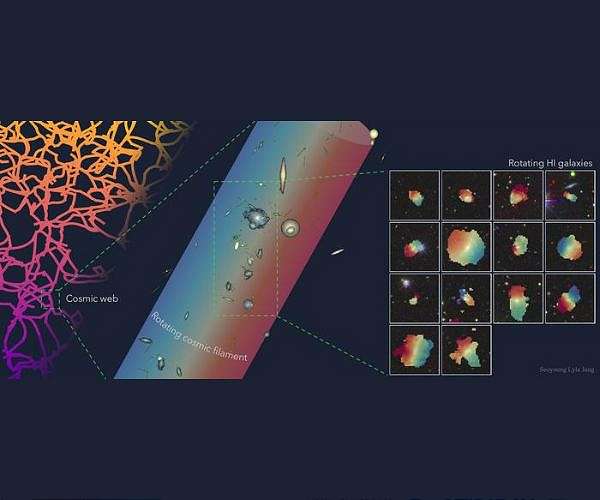
Cosmic filaments form the main framework of the cosmic web, consisting of long, thread-like arrangements of galaxies and dark matter that channel material across intergalactic space. These structures act as routes along which gas and angular momentum flow into galaxies, so nearby rotating filaments where many galaxies share a common spin direction provide a key testbed for understanding how galaxies acquire their rotation over tens of millions of light-years.

In this study, the researchers identified 14 nearby galaxies rich in atomic hydrogen arranged in a narrow configuration about 5.5 million light-years long and roughly 117,000 light-years across. This string sits within a much larger filament containing more than 280 galaxies and extending about 50 million light-years, where a significant fraction of the galaxies appear to rotate in the same sense as the filament itself, a level of alignment that exceeds expectations from random orientations and challenges current models of how strongly large-scale structures couple to galaxy spins.

Velocity measurements show that galaxies on opposite sides of the filament's central spine move in opposite directions along the line of sight, indicating that the system as a whole is rotating. By modelling the filament dynamics, the team inferred a rotation speed of about 110 kilometers per second and estimated a dense central region with a radius near 50 kiloparsecs, equivalent to roughly 163,000 light-years.

Co-lead author Dr Lyla Jung of the University of Oxford said: "What makes this structure exceptional is not just its size, but the combination of spin alignment and rotational motion. You can liken it to the teacups ride at a theme park. Each galaxy is like a spinning teacup, but the whole platform- the cosmic filament -is rotating too. This dual motion gives us rare insight into how galaxies gain their spin from the larger structures they live in."

The filament appears to be relatively young and undisturbed, with many gas-rich galaxies and low internal motions that indicate a dynamically cold state. Because hydrogen gas provides the basic fuel for star formation, these hydrogen-rich galaxies are still gathering or retaining material for new stars, giving a view of galaxy evolution at an early or ongoing stage.

Atomic hydrogen also serves as a sensitive tracer of motion, making hydrogen-rich galaxies effective markers of gas flows along filaments. Tracking how hydrogen is channelled through the filament into galaxies helps reveal how angular momentum is transported through the cosmic web and how this process shapes galaxy morphology, rotation, and star formation histories.

The discovery has implications for cosmological surveys that use weak gravitational lensing, where intrinsic alignments of galaxy shapes and spins can mimic or contaminate lensing signals. Detailed studies of structures like this filament will improve models of intrinsic alignments for missions such as the European Space Agency's Euclid observatory and the Vera C. Rubin Observatory in Chile, refining measurements of cosmic structure growth and dark matter distribution.

Co-lead author Dr Madalina Tudorache of the University of Cambridge and University of Oxford said: "This filament is a fossil record of cosmic flows. It helps us piece together how galaxies acquire their spin and grow over time."

The team combined radio observations from South Africa's MeerKAT array of 64 linked dishes with optical spectroscopy from the Dark Energy Spectroscopic Instrument and the Sloan Digital Sky Survey. Within the MIGHTEE deep survey, led by Professor of Astrophysics Matt Jarvis at the University of Oxford, these data revealed a filament that shows both coherent alignment of galaxy spins and bulk rotational motion, demonstrating the value of multi-observatory datasets for studying how large structures and galaxies form.

Professor Matt Jarvis said: "This really demonstrates the power of combining data from different observatories to obtain greater insights into how large structures and galaxies form in the Universe. Such studies can only be achieved by large groups with diverse skillsets, and in this case, it was really made possible by winning an ERC Advanced Grant/UKIR Frontiers Research Grant, which funded the co-lead authors."

The collaboration also included researchers from the University of Cambridge, the University of the Western Cape, Rhodes University, the South African Radio Astronomy Observatory, the University of Hertfordshire, the University of Bristol, the University of Edinburgh, and the University of Cape Town.

Research Report:A 15 Mpc rotating galaxy filament at redshift z = 0.032

Related Links
University of Oxford
Understanding Time and Space

Subscribe Free To Our Daily Newsletters
Tweet

RELATED CONTENT
The following news reports may link to other Space Media Network websites.
TIME AND SPACE
End of mission for Atacama Cosmology Telescope opens new avenues in cosmology
Paris, France (SPX) Nov 25, 2025
The Atacama Cosmology Telescope (ACT) has concluded nearly two decades of operation, closing a chapter in observational cosmology and initiating new directions for research. The ACT Collaboration has published three major papers in the Journal of Cosmology and Astroparticle Physics (JCAP), detailing the sixth and final ACT data release, which significantly advances knowledge about the evolution and state of the Universe. The latest ACT measurements confirm the value of the Hubble constant - a crit ... read more

TIME AND SPACE
Lunasa Space funding backs shared in orbit lab platform

Soyuz rocket positioned at Baikonur for ISS crew launch as Cygnus XL temporarily removed

NASA celebrates a decade of student contributions to space crop production

Micro nano robots aim to cut carbon buildup in closed life support systems

TIME AND SPACE
SyLEx test rocket gives France new suborbital launch option

AtSpace A01 reaches record suborbital altitude from Koonibba Test Range

LandSpace ZQ 3 Y1 rocket reaches orbit on first reusable flight attempt

South Korea advances Nuri rocket program with fourth orbital launch

TIME AND SPACE
Scientists trace ancient mega watersheds on Mars

Destination: Mars. First Stop: Iceland?

NASA Orbiter Shines New Light on Long-Running Martian Mystery

ESCAPADE spacecraft capture first images while en route to Mars

TIME AND SPACE
China supports private space firms to expand global reach

China launches Shenzhou-22 early for stranded space station crew

China consolidates new commercial space regulator and industry roadmap

Beijing space lab targets orbital data centers for AI era

TIME AND SPACE
EIB launches Space TechEU finance program for European space sector

Spire Global faces NYSE noncompliance as contract momentum collides with reporting delay

AST SpaceMobile increases US manufacturing capacity with new sites for next generation satellite production

BlueBird 6 satellite set for December launch to expand direct mobile connectivity in space

TIME AND SPACE
Platinum Crystals Mapped as They Develop Inside Liquid Metal

Roadmap sets circular economy agenda for space hardware and debris mitigation

Faraday Effect Reveals Magnetic Role of Light in New Study

Orbit Fab to lead ESA backed ASTRAL refuelling demo in orbit

TIME AND SPACE
SwRI opens NOUR lab to track chemical pathways from nebulae to planetary systems

SPHERE debris disk survey maps hidden asteroid and comet belts in young planetary systems

Helium escape mapped from superpuff exoplanet WASP 107b by JWST

Moss spores withstand long term exposure outside space station

TIME AND SPACE
Looking inside icy moons

Saturn moon mission planning shifts to flower constellation theory

Could these wacky warm Jupiters help astronomers solve the planet formation puzzle?

Out-of-this-world ice geysers on Saturn's Enceladus

Subscribe Free To Our Daily Newsletters


The content herein, unless otherwise known to be public domain, are Copyright 1995-2024 - Space Media Network. All websites are published in Australia and are solely subject to Australian law and governed by Fair Use principals for news reporting and research purposes. AFP, UPI and IANS news wire stories are copyright Agence France-Presse, United Press International and Indo-Asia News Service. ESA news reports are copyright European Space Agency. All NASA sourced material is public domain. Additional copyrights may apply in whole or part to other bona fide parties. All articles labeled "by Staff Writers" include reports supplied to Space Media Network by industry news wires, PR agencies, corporate press officers and the like. Such articles are individually curated and edited by Space Media Network staff on the basis of the report's information value to our industry and professional readership. Advertising does not imply endorsement, agreement or approval of any opinions, statements or information provided by Space Media Network on any Web page published or hosted by Space Media Network. General Data Protection Regulation (GDPR) Statement Our advertisers use various cookies and the like to deliver the best ad banner available at one time. All network advertising suppliers have GDPR policies (Legitimate Interest) that conform with EU regulations for data collection. By using our websites you consent to cookie based advertising. If you do not agree with this then you must stop using the websites from May 25, 2018. Privacy Statement. Additional information can be found here at About Us.