| . |  |
. |
| . | |
. |


 by Staff Writers Beijing (XNA) Jun 21, 2022
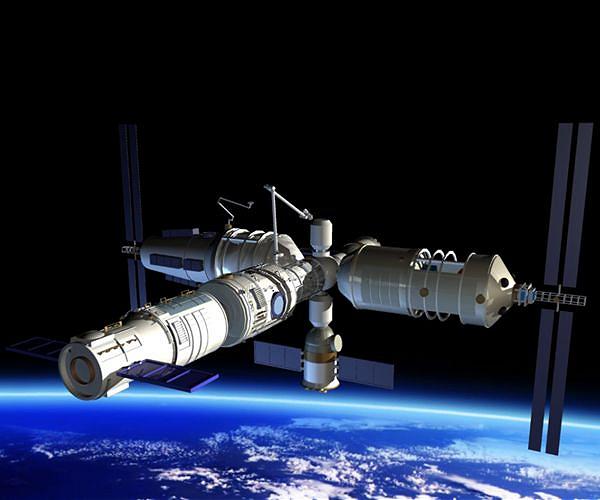
Chinese scientists have developed a metallic-based thermal-control coating for the Shenzhou-14 crewed spaceship that will protect the taikonauts from extreme heat and cold during their six-month stay in orbit. The new coating works in two ways: providing low solar absorption to help reduce the sun's effect on the spacecraft's interior temperature; and providing low infrared emittance to block heat release from internal sources. Tasked with completing the construction of China's Tiangong space station, the orbiting Shenzhou-14 taikonauts will witness several complex station configurations during their six-month journey. Cargo craft and lab modules that dock with the space station core module are likely to block the sunlight to the spaceship, resulting in long-term exposure to the extreme cold found in the shadows of deep space. The spaceship also has to cope with the intense heat found in the direct sunlight of outer space. Without thermal controls, the temperature of the spacecraft's sun-facing side can soar to above 100 degrees Celsius, while the dark side can plunge to minus 100 degrees Celsius. The extreme high- and low-temperature environments pose challenges to the health of the taikonauts and the functioning of the spacecraft. Developed by the China Academy of Space Technology, the thermal-control coating was first used on the Shenzhou-13 spacecraft, which was launched on Oct. 16, 2021. It kept the cabin environment within acceptable temperature ranges (between 18 and 26 degrees Celsius) during its six-month space journey, allowing the taikonauts to stay cool and comfortable in their orbiting home. China launched the three-person Shenzhou-14 mission on June 5, providing the third crew for the country's space-station project. During their stay in orbit, the crew will witness two lab modules, the Tianzhou-5 cargo craft and Shenzhou-15 crewed spaceship docking with the space station core module. Source: Xinhua News Agency
Smartphone technology provides satellites with increased computing power Braunschweig, Germany (SPX) Jun 14, 2022 Reliable and powerful computers play a central role in spaceflight - for example, computer systems in satellites enable sophisticated Earth observation missions. The German Aerospace Center is developing a new computer architecture that will provide On-Board Computers (OBCs) with more power as well as enabling them to repair themselves. Distributed heterogeneous OBCs are being created in the Scalable On-Board Computing for Space Avionics (ScOSA) flight experiment project. They feature different computin ... read more
|
|||||||||||||
| The content herein, unless otherwise known to be public domain, are Copyright 1995-2026 - SpaceDaily. All websites are published in Australia and are solely subject to Australian law and governed by Fair Use principals for news reporting and research purposes. By using our websites you consent to cookie based advertising. If you do not agree with this then you must stop using the websites from May 25, 2018. Privacy Statement. Additional information can be found here at About Us. |

 del.icio.us
 Digg
Digg Reddit
 Google






