| . |  |
. |
| . | |
. |


 by Staff Writers Portland OR (SPX) Mar 04, 2020
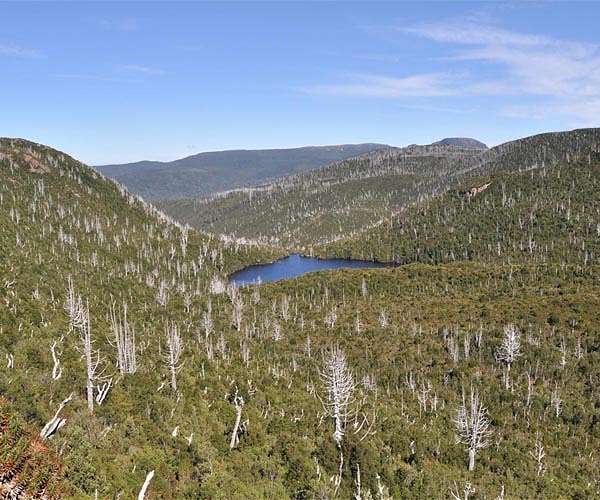
Tasmania's ancient rainforest faces a grim future as a warming climate and the way people used the land have brought significant changes to the island state off mainland Australia's southeastern coast, according to a new Portland State University study. The study holds lessons not only for Australia - whose wildfires have been dominating Ancient Australian trees face uncertain future under climate changes in recent months - but for other areas of the world that are seeing drying conditions and increased risk of wildfires. Andres Holz, the study's lead author and associate professor of geography at PSU's College of Liberal Arts and Sciences, studied the population decline of King Billy pine trees (Athrotaxis selaginoides), a coniferous species native to Tasmania that dates back to when Australia was part of a supercontinent called Gondwana. This paleoendemic tree species occupies large tracks of the UNESCO World Heritage Area in Tasmania and is considered a vulnerable species by the World Conservation Union. The study found that increasingly frequent fires caused by regional dry and warming trends and increased ignitions - by humans during the early arrival of Europeans to Tasmania and more recently due to increases in lightning - are breaching fire refugia. Refugia are protected areas that don't burn or, if they do, are areas where trees survive most wildfires. "The areas that have survived are in these very protected refugia," Holz said. "The refugia can be a bit of a buffer, but how long is that going to last? We might be witnesses of a whole lineage of a very ancient plant species that is going to go extinct." Holz said that the changes in how wildfires function, due to both management and climate change, are driving analogous ecosystem transformations not only in Australia, but also western North America and South America's Patagonia region. Untangling the complex relationships between landscape, fire disturbance, human fire usage, climate variability and anthropogenic climate change is key to understanding the rapid population declines of King Billy pines. The study found that the trees regenerated continuously before 1800AD under indigenous land management, but population declines followed European colonization as they cleared land for logging and mining. This coincided with a period of more fire-prone climate and weather conditions. "Fires co-occur with dry, warm periods and those periods are more and more frequent now," Holz said, adding that the Billy King pines need wet and cool conditions to thrive. "We're moving away, climatically speaking, from the drivers that help the species." Holz and the research team also found few seedlings or saplings in the study area, meaning that recovery of the original forest is unlikely. Instead, the replacement forest has become a tall-shrubland ecosystem with lower species diversity that in turn are more flammable and recover more quickly following fire. "The next time there are the same climate conditions and there's a spark, a lightning strike or an accidental fire, the plants themselves are now more dense in space and more flammable than before and have a higher change of burning again," Holz said. "It becomes a vicious cycle that is hard to break." The study said that as these critical climate-fire associations increase in strength, the survival of King Billy pines may require increasingly targeted fire management, including rapid attack of uncontrolled fires.
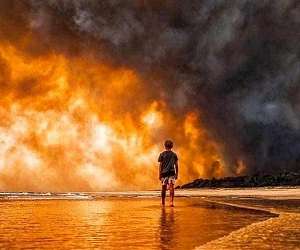
Bushfires burned a fifth of Australia's forest: study Paris (AFP) Feb 24, 2020 Australia's wildfires have destroyed more than a fifth of the country's forests, making the blazes "globally unprecedented" following a years-long drought linked to climate change, researchers said Monday. Climate scientists are currently examining data from the disaster, which destroyed swathes of southeastern Australia, to determine to what extent they can be attributed to rising temperatures. In a special edition of the journal Nature Climate Change, Australian researchers examined several o ... read more
|
|||||||||||||
| The content herein, unless otherwise known to be public domain, are Copyright 1995-2026 - SpaceDaily. All websites are published in Australia and are solely subject to Australian law and governed by Fair Use principals for news reporting and research purposes. By using our websites you consent to cookie based advertising. If you do not agree with this then you must stop using the websites from May 25, 2018. Privacy Statement. Additional information can be found here at About Us. |

 del.icio.us
 Digg
Digg Reddit
 Google







