| . |  |
. |
| . | |
. |


 by Staff Writers Brooklyn NY (SPX) Feb 08, 2018
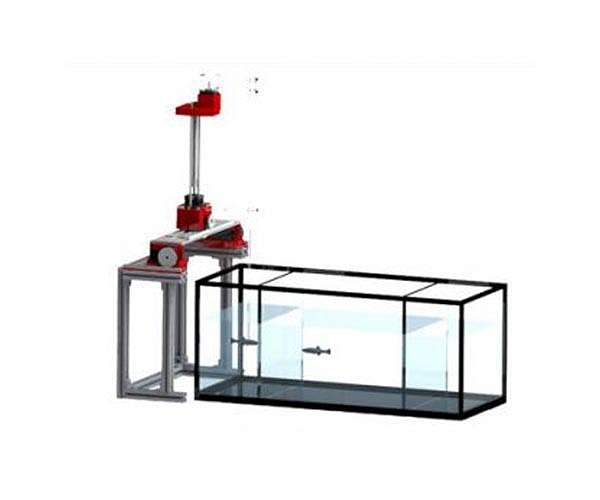
For more than a decade, biomimetic robots have been deployed alongside live animals to better understand the drivers of animal behavior, including social cues, fear, leadership, and even courtship. The encounters have always been unidirectional; the animals observe and respond to the robots. But in the lab of Maurizio Porfiri, a professor of mechanical and aerospace engineering at the NYU Tandon School of Engineering, the robots can now watch back. Porfiri and a team of collaborators tapped advances in real-time tracking software and robotics to design and test the first closed-loop control system featuring a bioinspired robotic replica interacting in three dimensions with live zebrafish. The system allows the robotic replica to both "see" and mimic the behavior of live zebrafish in real time. The results of these experiments, which represent the first of their kind with zebrafish, were published in Scientific Reports. The team tested the interaction of the robotic replica and live zebrafish under several different experimental conditions, but in all cases, the replica and the live fish were separated by a transparent panel. In preference tests, zebrafish showed greater affinity- and, importantly, no signs of anxiety or fear - toward a robotic replica that mirrored its own behavior rather than a robot that followed a pre-set pattern of swimming. Porfiri noted that while mirroring is a basic, limited form of social interaction, these experiments are a powerful first step toward enriching the exchange between robots and live animals. "This form of mirroring is a very simple social behavior, in which the replica seeks only to stay as close as possible to the live animal. But this is the baseline for the types of interactions we're hoping to build between animals and robots," Porfiri said. "We now have the ability to measure the response of zebrafish to the robot in real time, and to allow the robot to watch and maneuver in real time, which is significant." The researchers are now investigating social interactions among live zebrafish to better understand the animals' natural cues and responses. "We are learning what really matters in zebrafish social interactions, and we can use this information to help the robot interpret and respond appropriately, rather than just copying what it sees," he said.
Research Report: "Closed-loop Control of Zebrafish Behavior in Three Dimensions Using a Robotic Stimulus"
Integration of AI and robotics with materials sciences will lead to new clean energy technology Toronto, Canada (SPX) Feb 08, 2018 Materials are the foundation of essentially all clean energy technologies including advanced batteries, solar cells, low-energy semiconductors, catalysts for capturing and storing CO2, and more. But discovering new materials is currently a time consuming and expensive process: to determine whether they will be useful, newly discovered molecules are run through simulation, synthesis, and testing in an expensive process that can take 10 to 20 years. Artificial intelligence and robotics combined with ... read more
|
|||||||||||||
| The content herein, unless otherwise known to be public domain, are Copyright 1995-2026 - SpaceDaily. All websites are published in Australia and are solely subject to Australian law and governed by Fair Use principals for news reporting and research purposes. By using our websites you consent to cookie based advertising. If you do not agree with this then you must stop using the websites from May 25, 2018. Privacy Statement. Additional information can be found here at About Us. |

 del.icio.us
 Digg
Digg Reddit
 Google







