| . |  |
. |
| . | |
. |


 by Staff Writers Washington DC (SPX) Aug 30, 2018
New work from Carnegie's Jonathan Gagne and the American Museum of Natural History's Jacqueline Faherty identified nearly a thousand potential members and 31 confirmed members of stellar associations - stars of similar ages and compositions that are drifting together through space - in our own corner of the Milky Way. Their work, published in the Astrophysical Journal, could help astronomers understand the evolution of stars and the properties of future exoplanet discoveries. "Like a swarm of birds flying together in the sky, the common velocities of stars in an association tell us that us that they are related," Gagne explained. "This teaches us something about their age and their compositions," Thanks to internal similarities between group members and external differences between different groups - particularly when it comes to member ages - astronomers can use stellar associations to glean information about the history of star formation in our corner of the Milky Way. These stars' ages vary from a few million to a billion years old, depending on the group, a range that offers astronomers a sweeping view of stellar evolution among our neighbors. Gagne and Faherty combed through data from the European Space Agency's three-dimensional mapping mission of our galaxy, Gaia, which was released earlier this year, to discover this goldmine of confirmed and potential group members. "Our sample is mostly comprised of stars called red dwarfs, which are smaller than our Sun and relatively cool," Gagne said. "Because of their size, they can be difficult to observe, although we know that they are extremely common in the galaxy, which is why the Gaia data is such a great windfall." What they learn about these stars could also inform astronomers' understanding of planets or planet-like objects found within their associations by upcoming space-based missions. "If future missions like NASA's Transiting Exoplanet Survey Satellite, or TESS, are able to find exoplanets orbiting our stellar neighbors, the information we've gathered about their ages based on their membership in one of these associations, will be able to teach us a great deal about what planetary system evolution looks like at different points in time," added Faherty, who is a Carnegie alumna. In addition to the bonanza of red dwarf members of neighboring stellar associations, Gagne and Faherty discovered 111 brown dwarfs that are part of these local associations. Brown dwarfs are sometimes called failed stars or super Jupiters. They're smaller than stars - too small to sustain the hydrogen fusion process - but more massive than giant planets. As such, they provide a natural link between astronomy and planetary science and are of great interest to scientists.
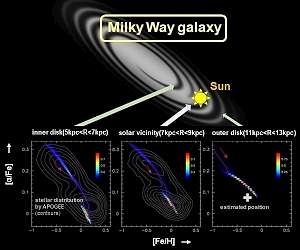
Stars memorize rebirth of our home galaxy Sendai, Japan (SPX) Aug 24, 2018 The Milky Way galaxy has died once before and we are now in what is considered its second life. Calculations by Masafumi Noguchi (Tohoku University) have revealed previously unknown details about the Milky Way. These were published in the July 26 edition of Nature. Stars formed in two different epochs through different mechanisms. There was a long dormant period in between, when star formation ceased. Our home galaxy has turned out to have a more dramatic history than was originally thought. ... read more
|
|||||||||||||
| The content herein, unless otherwise known to be public domain, are Copyright 1995-2026 - SpaceDaily. All websites are published in Australia and are solely subject to Australian law and governed by Fair Use principals for news reporting and research purposes. By using our websites you consent to cookie based advertising. If you do not agree with this then you must stop using the websites from May 25, 2018. Privacy Statement. Additional information can be found here at About Us. |


 del.icio.us
 Digg
Digg Reddit
 Google







