| . |  |
. |
| . | |
. |


 by Staff Writers Paris (ESA) May 01, 2020
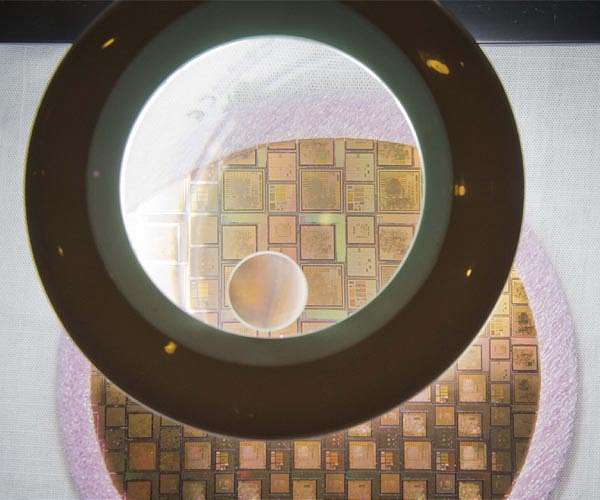
Tiny integrated circuits destined for space missions, etched onto a single wafer of silicon, examined under a magnifier. To save money on the high cost of fabrication, various chips designed by different companies and destined for multiple ESA projects are crammed onto the same silicon wafers, etched into place at specialised semiconductor manufacturing plants or 'fabs'. Once manufactured, the chips, still on the wafer, are tested. The wafers are then chopped up. They become ready for use when placed inside protective packages - just like standard terrestrial microprocessors - and undergo final quality tests. Through little metal pins or balls sticking out of their packages these miniature brains are then connected to other circuit elements - such as sensors, actuators, memory or power systems - used across the satellite. Considering the time and money needed to develop complex chips like these, ESA's Microelectronics section maintains a catalogue of chip designs, known as Intellectual Property (IP) cores, available to European industry through ESA licence. Think of these IP cores as the tiniest mission 'building blocks': specialised designs to perform particular tasks in space, laid down within a microchip. These range from single 'simpler' functions such as decoding signals from Earth to control the satellite to highly complex computer tasks such as operating a complete spacecraft.
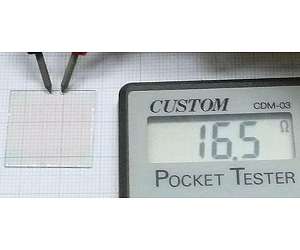
The future of semiconductors is clear Tokyo, Japan (SPX) Apr 24, 2020 Mobility is a key parameter for semiconductor performance and relates to how quickly and easily electrons can move inside a substance. Researchers have achieved the highest mobility among thin films of tin dioxide ever reported. This high mobility could allow engineers to create thin and even transparent tin dioxide semiconductors for use in next-generation LED lights, photovoltaic solar panels or touch-sensitive display technologies. Tin and oxygen are very familiar elements, and when combi ... read more
|
|||||||||||||
| The content herein, unless otherwise known to be public domain, are Copyright 1995-2026 - SpaceDaily. All websites are published in Australia and are solely subject to Australian law and governed by Fair Use principals for news reporting and research purposes. By using our websites you consent to cookie based advertising. If you do not agree with this then you must stop using the websites from May 25, 2018. Privacy Statement. Additional information can be found here at About Us. |

 del.icio.us
 Digg
Digg Reddit
 Google







