| . |  |
. |
| . | |
. |


 by Staff Writers Bochum, Germany (SPX) Jan 22, 2016
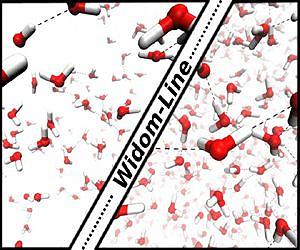
Using molecular dynamics simulations, researchers have analysed the properties of supercritical water. The researchers showed which structure of the hydrogen bond network is formed in different supercritical states and also simulated the relevant terahertz spectra. This approach may help in future to interpret experimental results. At temperatures of approx. 375 degrees Celsius and a pressure 220 times higher than normal, water reaches the supercritical state, where the liquid and the gaseous phases can no longer be clearly distinguished - according to traditional text-book opinion. "Arguments that the supercritical state might be subdivided into a gas-like and a liquid-like regime, separated by the so-called Widom line, haven't been put forward until a few years ago," explains Christoph Schran from the Center for Theoretical Chemistry at the Ruhr-Universitat Bochum, headed by Prof Dr Dominik Marx.
Three water states in comparison The theorists compared three states: the state of liquid water at room temperature; a supercritical state with high density; and a supercritical state with low density. The analyses revealed that the hydrogen bond networks between the hydrogen molecules are completely different in those three states.
States differ with regard to size and number of water clusters The number of clusters of different sizes differs between supercritical states with high and low density. Properties of the gas phase are prevailing in supercritical water with low density, those of the liquid phase in supercritical water with high density. The researchers simulated the vibrational spectra associated with the three states in the terahertz range, whose shape is largely determined by the structure of the hydrogen bond network. Experimentally, it is not possible to observe directly which factors affect the shape of the spectra on the molecular level. Theoretical chemistry can close this gap: the present study has shed light on the physical processes that determine the shape of the terahertz spectra of gas-like and liquid-like supercritical water. "Our simulations have shown that terahertz spectroscopy should be an ideal method for analysing the properties of hydrogen bonds in the supercritical state of water - on both sides of the Widom line," concludes Schran. "Moreover, our findings will help to interpret the underlying molecular processes in the measured spectra."
Supercritical liquids as solvents for the industry M. Smiechowsk, C. Schran, H. Forbert, D. Marx (2016): Correlated particle motion and THz spectral response of supercritical water, Physical Review Letters, DOI: 10.1103/PhysRevLett.116.027801
Related Links Ruhr-University Bochum Space Technology News - Applications and Research
|
|||||||||||||
| The content herein, unless otherwise known to be public domain, are Copyright 1995-2026 - SpaceDaily. All websites are published in Australia and are solely subject to Australian law and governed by Fair Use principals for news reporting and research purposes. By using our websites you consent to cookie based advertising. If you do not agree with this then you must stop using the websites from May 25, 2018. Privacy Statement. Additional information can be found here at About Us. |


 del.icio.us
 Digg
Digg Reddit
 Google