

24/7 Space News
EARTH OBSERVATION
NASA backs CINEMA smallsat fleet to probe Earth magnetotail
illustration only

NASA backs CINEMA smallsat fleet to probe Earth magnetotail

by Clarence Oxford
Laurel MD (SPX) Dec 14, 2025

NASA has selected Dartmouth College and the Johns Hopkins Applied Physics Laboratory (APL) in Laurel, Maryland, to begin developing a mission that will shed more light on the growing impacts of space weather.

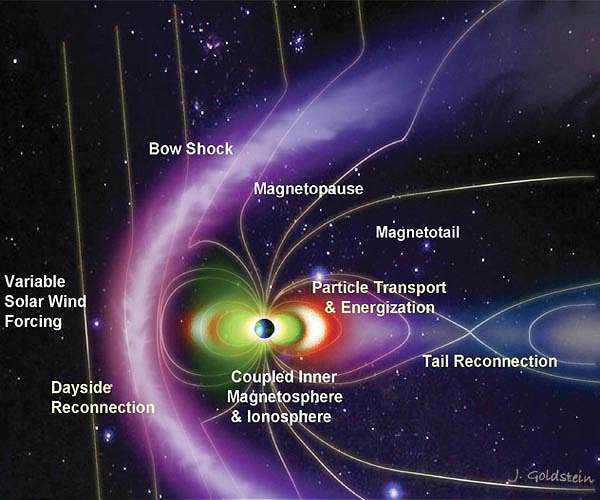
The Cross-scale Investigation of Earths Magnetotail and Aurora (CINEMA) mission will unlock the secrets of the energy circulation through Earths magnetotail. The magnetotail is an extension of our planets magnetic field created by solar wind streamed from the Sun, and as energy accumulates, it can release energy explosively and power intense geomagnetic storms and substorms.

That energy contributes to the phenomenon of space weather, the set of events fueled by solar activity that range from auroral displays at Earths poles to releases that can affect satellite safety, air travel and ground infrastructure. CINEMA will examine how these processes connect and evolve across near-Earth space.

Using nine small satellites, each carrying three science instruments, CINEMA will provide a coordinated view of the magnetotail, the aurora and their role in how the magnetosphere functions. The mission will investigate what causes the magnetosphere to release energy explosively and how particles from the Sun steadily move through Earths magnetic field.

"We're thrilled that NASA has selected CINEMA as the next SMEX mission. This is an exciting moment for our team and our partners, whose creativity, dedication, and expertise shaped a mission designed to answer some of the most compelling questions in heliophysics," said Robyn Millan, principal investigator for the mission and an experimental physicist at Dartmouth. "CINEMA's innovative multi-spacecraft approach will give us a perspective on Earth's magnetotail that we've never had before, opening the door to discoveries that will meaningfully advance our understanding of the Sun-Earth system.".

The mission will significantly improve understanding of the energetic connection between the Sun and Earth and provide insight into how similar environments in space could affect future human exploration. "CINEMA provides a critical tool to aid our understanding of space weather," said Bobby Braun, head of APL's Space Exploration Sector. "We're thrilled that NASA recognizes the scientific value CINEMA will deliver and we're excited to start working with our partners to implement this mission.".

Dartmouth College in Hanover, New Hampshire, is the CINEMA principal investigator institution, while APL will manage the mission, provide critical instrumentation and integrate the payload. The University of California, Berkeley, in partnership with Space Dynamics Laboratory, will supply auroral imaging instruments, and Blue Canyon Technologies of Lafayette, Colorado, will provide the small spacecraft and operate the mission.

Related Links
Johns Hopkins University Applied Physics Laboratory
Earth Observation News - Suppiliers, Technology and Application

Subscribe Free To Our Daily Newsletters
Tweet

RELATED CONTENT
The following news reports may link to other Space Media Network websites.
EARTH OBSERVATION
Aechelon links Vantor 3D terrain with Orbion SkyBeam to boost ICEYE SAR AI
Los Angeles CA (SPX) Dec 08, 2025
Aechelon Technology has completed a proof-of-concept integration of Vantor's 3D Operational Terrain into its Project Orbion SkyBeam AI exploitation system, using ICEYE's space-based synthetic aperture radar data to generate physics-accurate 3D terrain environments for time-sensitive missions and training. The system converts ICEYE's high-resolution SAR imagery into detailed 3D visualizations that will be demonstrated interactively at I/ITSEC 2025 in Orlando, Florida. Within SkyBeam, Aechelon ... read more

EARTH OBSERVATION
ISS to change commanders before Soyuz crew leaves orbit

Micro nano robots aim to cut carbon buildup in closed life support systems

NASA extends ISS National Lab management contract through 2030

NASA celebrates a decade of student contributions to space crop production

EARTH OBSERVATION
EU dismisses 'completely crazy statements' after Musk attack

Space shuttle design study maps path to breakthrough inventions

Sea based rocket net recovery platform enters service for Chinese reusable launchers

EU hits Musk's X with 120-mn-euro fine, sparking US ire

EARTH OBSERVATION
Martian butterfly crater reveals low angle impact and buried lava history

Bacterial partnership offers pathway to produce Mars regolith bricks for future habitats

Chinese team runs long term Martian dust cycle simulation with GoMars model

NASA rover hears electric crackles inside Mars dust devils

EARTH OBSERVATION
Wenchang spaceport hits record cadence with double-digit launches in 2025

China consolidates new commercial space regulator and industry roadmap

Beijing space lab targets orbital data centers for AI era

China supports private space firms to expand global reach

EARTH OBSERVATION
Applied Aerospace and PCX create US flight and space hardware group

EIB launches Space TechEU finance program for European space sector

Iridium wins five year US Space Force contract to upgrade EMSS infrastructure

Satellite surge threatens space telescopes, astronomers warn

EARTH OBSERVATION
Digital twin successfully launched and deployed into space

IBM says buying data management firm Confluent for $11 bn

Data centers: a view from the inside

Microsoft announces $17.5 bn investment in India, its 'largest ever' in Asia

EARTH OBSERVATION
NASA backs WHOI effort to read organic signals from ocean worlds

SPHERE debris disk survey maps hidden asteroid and comet belts in young planetary systems

SwRI opens NOUR lab to track chemical pathways from nebulae to planetary systems

Gels may have given early Earth chemistry a place to organize into life

EARTH OBSERVATION
SwRI links Uranus radiation belt mystery to solar storm driven waves

Looking inside icy moons

Saturn moon mission planning shifts to flower constellation theory

Could these wacky warm Jupiters help astronomers solve the planet formation puzzle?

Subscribe Free To Our Daily Newsletters


The content herein, unless otherwise known to be public domain, are Copyright 1995-2024 - Space Media Network. All websites are published in Australia and are solely subject to Australian law and governed by Fair Use principals for news reporting and research purposes. AFP, UPI and IANS news wire stories are copyright Agence France-Presse, United Press International and Indo-Asia News Service. ESA news reports are copyright European Space Agency. All NASA sourced material is public domain. Additional copyrights may apply in whole or part to other bona fide parties. All articles labeled "by Staff Writers" include reports supplied to Space Media Network by industry news wires, PR agencies, corporate press officers and the like. Such articles are individually curated and edited by Space Media Network staff on the basis of the report's information value to our industry and professional readership. Advertising does not imply endorsement, agreement or approval of any opinions, statements or information provided by Space Media Network on any Web page published or hosted by Space Media Network. General Data Protection Regulation (GDPR) Statement Our advertisers use various cookies and the like to deliver the best ad banner available at one time. All network advertising suppliers have GDPR policies (Legitimate Interest) that conform with EU regulations for data collection. By using our websites you consent to cookie based advertising. If you do not agree with this then you must stop using the websites from May 25, 2018. Privacy Statement. Additional information can be found here at About Us.







