| . |  |
. |
| . | |
. |


 by Staff Writers New Delhi (Sputnik) Nov 22, 2019
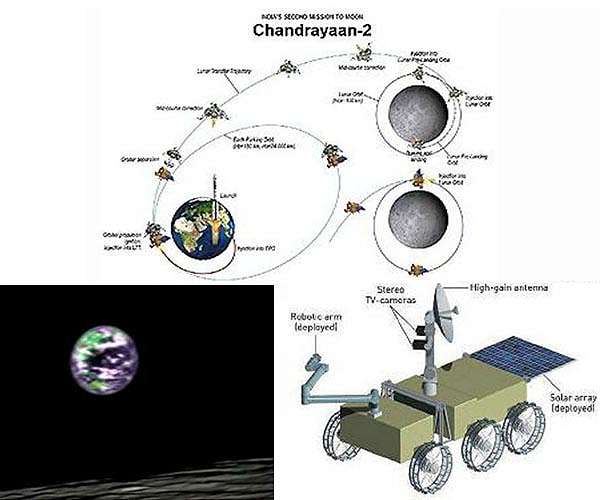
India's ambition to soft-land on the Moon crash-landed when the Chandrayaan-2 failed to touch-down on the lunar surface as planned on 7 September. Its orbiter, however, continued to perform "as per the design providing valuable scientific data". India's Federal Space Minister Dr Jitendra Singh admitted for the first time that the failure of the Chadrayaan-2 was due to a reduction in velocity beyond the designed parameters. "During the second phase of descent, the reduction in velocity was more than the designed value. Due to this deviation, the initial conditions at the start of the fine braking phase were beyond the designed parameters. As a result, Vikram hard landed within 500 m of the designated landing site", Dr Singh told parliamentarians. The minister, however, said that all the eight state-of-the-art scientific instruments of the orbiter were performing as per the design. He said that the data sent by the orbiter is being studied by the scientific community. Ajay Lele, a space technology expert, said there would be different types of atmospheric pressures, which could have affected the soft-landing. "As far as they (ISRO) were concerned, the design was okay. But it must have experienced some sort of a situation, which was not thought of. It happens with these kinds of missions", said Lele. The Chandrayaan-2, with all its domestically-made payloads, began its voyage on 22 July from the ISRO's spaceport on the eastern coast of Sriharikota in Andhra Pradesh. After an initial hiccup, it crossed all hurdles seamlessly, but lost contact with the ISRO's Earth Station just minutes before the scheduled soft-landing near the Moon's south pole. Meanwhile, Indian Space Research Organisation (ISRO) Chief Dr K. Sivan said that the Chandrayaan-2 is "not the end of the story" and that the space agency would attempt another landing on the Moon's south pole in the near future. Source: RIA Novosti
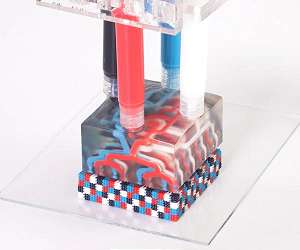
Multimaterial 3D printing manufactures complex objects, fast Boston MA (SPX) Nov 15, 2019 3D printers are revolutionizing manufacturing by allowing users to create any physical shape they can imagine on-demand. However, most commercial printers are only able to build objects from a single material at a time and inkjet printers that are capable of multimaterial printing are constrained by the physics of droplet formation. Extrusion-based 3D printing allows a broad palette of materials to be printed, but the process is extremely slow. For example, it would take roughly 10 days to build a ... read more
|
|||||||||||||
| The content herein, unless otherwise known to be public domain, are Copyright 1995-2026 - SpaceDaily. All websites are published in Australia and are solely subject to Australian law and governed by Fair Use principals for news reporting and research purposes. By using our websites you consent to cookie based advertising. If you do not agree with this then you must stop using the websites from May 25, 2018. Privacy Statement. Additional information can be found here at About Us. |

 del.icio.us
 Digg
Digg Reddit
 Google






