| . |  |
. |
| . | |
. |


 by Staff Writers Paris (ESA) Nov 21, 2019
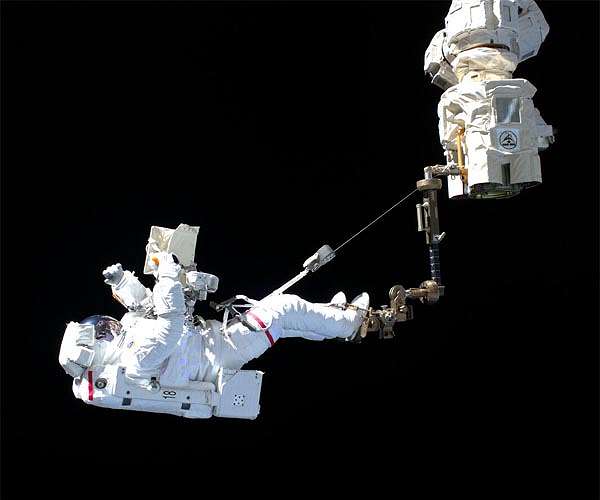
The first spacewalk to service the Alpha Magnetic Spectrometer (AMS) could not have gone better. Lead spacewalker ESA astronaut Luca Parmitano is imaged here hitching a ride on the International Space Station's 16-metre long robotic arm to kick off the first of four ventures to service the particle physics detector on 15 November. While all spacewalks are a carefully planned and detailed affair, the four spacewalks for AMS are exceptionally difficult as the bus-sized dark matter detector was never designed to be maintained in space. But after three successful years of delivering ground breaking science, the decision was made to extend its lifetime. The cooling pumps for AMS-02 need maintenance and without them it will no longer be able to collect data on the cosmic rays that are bombarding our planet. The first question spacewalk designers had to answer whether this was even possible. The first spacewalk proved it was not only possible, but thanks to the planning and trained that began as early as 2017, Luca and his spacewalking partner Andrew Morgan could achieve more than scheduled - setting them in good stead for the next phase. The spacewalk began, as they all do, with "prebreathing" for up to two hours. Similar to scuba divers, astronauts can suffer from the 'bends': quickly changing pressure can turn the nitrogen in human bodies into bubbles with serious symptoms. To avoid this, astronauts breathe pure oxygen to purge their bodies of nitrogen. Luca and NASA astronaut Drew Morgan left the depressurised Quest airlock at 13:10 CET (12:10 GMT), with Luca grabbing the ride to AMS on the robotic arm controlled by NASA astronaut Jessica Meir while Drew ferried handrails and equipment by hand to the worksite. The main task of this spacewalk was to remove the debris shield covering AMS, with an estimated three hours portioned for this task. Luca and Drew managed to jettison the debris shield to burn up safely in Earth's atmosphere well ahead of schedule. Luca and Drew also installed three handrails in the vicinity of AMS to prepare for the next spacewalks and removed zip ties on the AMS' vertical support strut. Amazingly, the duo were still well ahead of the six hours planned for the main task of removing the debris shield. When time permits, mission control give spacewalkers some "get ahead" tasks. Although there were no get-ahead tasks planned for this spacewalk the duo was so far ahead of schedule that mission control agreed they continue work originally planned for the second AMS spacewalk. Luca removed the screws from a carbon-fibre cover under the insulation and passed the cover to Drew to jettison once again. The pair cleaned up, took some photos of their killer views, gathered tools, and made their way back to the airlock, clocking in 6 hours and 39 minutes for this promising start to AMS maintenance.
NASA overpaid Boeing by hundreds of millions of dollars: auditor Washington (AFP) Nov 15, 2019 NASA "overpaid" Boeing by hundreds of millions of dollars on a fixed contract to develop a spaceship to carry astronauts to the International Space Station (ISS), an audit report has said, compensation it called "unnecessary." The US has relied on Russia to transport its crews to the ISS since the end of the Space Shuttle program in 2011, but has hired Boeing and SpaceX under multi-billion dollar contracts, with the two companies already two years behind schedule. "We found that NASA agreed to p ... read more
|
|||||||||||||
| The content herein, unless otherwise known to be public domain, are Copyright 1995-2026 - SpaceDaily. All websites are published in Australia and are solely subject to Australian law and governed by Fair Use principals for news reporting and research purposes. By using our websites you consent to cookie based advertising. If you do not agree with this then you must stop using the websites from May 25, 2018. Privacy Statement. Additional information can be found here at About Us. |

 del.icio.us
 Digg
Digg Reddit
 Google






