| . |  |
. |
| . | |
. |


 by Staff Writers Beijing (XNA) Oct 19, 2018
An asteroid has been named after the university of China's top science academy, with approval from the Minor Planet Center of the International Astronomical Union (IAU). Asteroid Guokeda (University of Chinese Academy of Sciences), coded 189018, was discovered on Oct. 14, 1998 by astronomers with the Beijing Schmidt CCD Asteroid Program at the Xinglong observatory in northern China, according to a recent IAU communique. With an absolute magnitude of 15.2, the asteroid orbits in an asteroid belt between Mars and Jupiter. Its orbital period is 5.33 years. A senior official with the university read the communique at an event Sunday to celebrate its 40th founding anniversary. Guokeda is the Chinese abbreviation of the University of the Chinese Academy of Sciences, which was founded in 1978 as the first and largest graduate education institution in China. The university granted the country's first Ph.D.s in science and in engineering. In 2014, it began to recruit undergraduates. The university has conferred degrees on more than 160,000 students so far, including nearly 80,000 doctorates. The Chinese Academy of Sciences is China's highest academic institution in natural sciences, and the most important training base for advanced scientific talent. Other Chinese universities including Peking University, Tianjin University and Harbin Institute of Technology, have also been used as names for asteroids. Source: Xinhua News
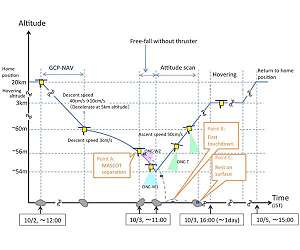
Saft batteries power MASCOT on Asteroid Ryugu Paris, France (SPX) Oct 17, 2018 Saft, the leader in batteries for space, is celebrating the success of the MASCOT (Mobile Asteroid Surface Scout), an asteroid lander designed to research the origins of the solar system, which relied on a Saft battery system as its power source. After MASCOT disconnected from the Hayabusa 2 craft, the battery system powered four scientific instruments as well as the on-board computer, navigation sensors and communication system. In addition, the battery provided power for a 'hopping' mechan ... read more
|
|||||||||||||
| The content herein, unless otherwise known to be public domain, are Copyright 1995-2026 - SpaceDaily. All websites are published in Australia and are solely subject to Australian law and governed by Fair Use principals for news reporting and research purposes. By using our websites you consent to cookie based advertising. If you do not agree with this then you must stop using the websites from May 25, 2018. Privacy Statement. Additional information can be found here at About Us. |

 del.icio.us
 Digg
Digg Reddit
 Google







