| . |  |
. |
| . | |
. |


 by Staff Writers Edinburgh UK (SPX) Mar 13, 2019
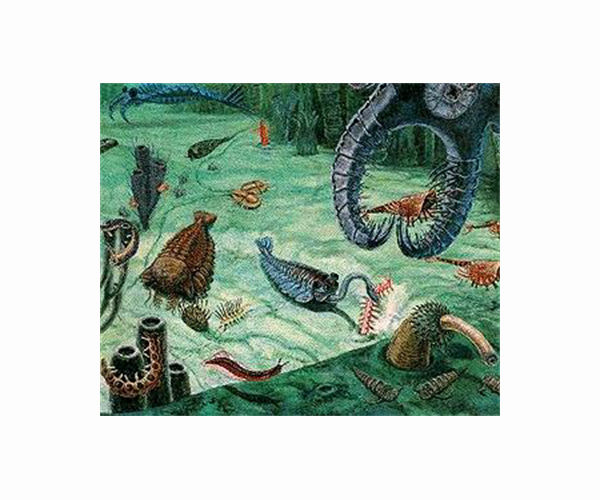
Scientists are rethinking a major milestone in animal evolution, after gaining fresh insights into how life on Earth diversified millions of years ago. Bursts of evolutionary activity that increased the number and variety of animals began earlier, occurred over a longer timeframe, and were more frequent than previously thought, researchers say. Their findings challenge a long-held theory that suggests the huge expansion in the types of animals on the planet more than 500 million years ago was triggered by a single, rapid surge of evolution - known as the Cambrian Explosion. Geoscientists from the University of Edinburgh re-assessed the timeline of early animal evolution by analysing records of fossil discoveries and environmental change. Until now, the Cambrian Explosion - which took place between 540 and 520 million years ago - was thought to have given rise to almost all the early ancestors of present-day animals. Scientists say, however, that it was probably just one in a series of similar events, the first of which took place at least 571 million years ago during the late Ediacaran Period. These bursts of evolutionary activity may have coincided with dramatic fluctuations in the levels of oxygen and essential nutrients in the oceans, the team says. The review is published in the journal Nature Ecology and Evolution. It was supported by the Natural Environment Research Council. The research also involved the Universities of Bristol, Cambridge and Helsinki, Tokyo Institute of Technology, Japan, and Memorial University of Newfoundland in Canada. Professor Rachel Wood, of the University of Edinburgh's School of GeoSciences, who led the study, said: "Integrating data from the fossil record with that of environmental changes that affected the whole planet is revealing the patterns and drivers of the rise of complex life on Earth. We used to think early animals emerged rapidly following a single evolutionary event, but our findings suggest it actually happened in stages."
New wallaby-sized dinosaur from the ancient Australian-Antarctic rift valley Cambridge UK (SPX) Mar 13, 2019 A new, wallaby-sized herbivorous dinosaur has been identified from five fossilized upper jaws in 125 million year old rocks from the Cretaceous period of Victoria, southeastern Australia. Reported in the Journal of Paleontology, the new dinosaur is named "Galleonosaurus dorisae," and is the first dinosaur named from the Gippsland region of Australia in 16 years. According to Dr Matthew Herne, a Postdoctoral Fellow at the University of New England, NSW, and lead author of the new study, "the jaws o ... read more
|
|||||||||||||
| The content herein, unless otherwise known to be public domain, are Copyright 1995-2026 - SpaceDaily. All websites are published in Australia and are solely subject to Australian law and governed by Fair Use principals for news reporting and research purposes. By using our websites you consent to cookie based advertising. If you do not agree with this then you must stop using the websites from May 25, 2018. Privacy Statement. Additional information can be found here at About Us. |

 del.icio.us
 Digg
Digg Reddit
 Google







