| . |  |
. |
| . | |
. |


 by Staff Writers London (AFP) Nov 5, 2015
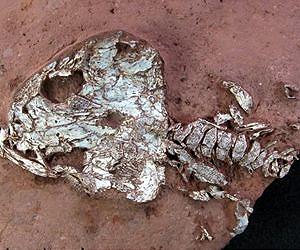
Scientists have discovered two previously unknown salamander-like creatures that lived 278 million years ago in Brazil that could shed light on how animals respond to climate change, Britain's Natural History Museum said on Thursday. Fossils of the amphibians were discovered alongside the oldest reptile skeleton ever found in South America by an international team of scientists from the Natural History Museum, Argentina, Germany and other countries. The discovery was announced in a study in the journal Nature. "The find fills an important geographic gap in our understanding of the evolution and adaptation of amphibians, a group that is increasingly under threat today from environmental change," the Natural History Museum said in a statement. The two species were aquatic amphibians, named timonya annae and procuhy nazariensis. Timonya annae was a fanged creature that reached 40 centimetres in length and looked like a cross between a modern Mexican salamander and an eel, according to the research. A close relative, procuhy nazariensis would have reached a similar size. Palaeontologist Martha Richter described the discovery as "remarkable" as most knowledge of four-legged vertebrates from the period is limited to North America and Western Europe, with little known about what animals lived in the southern tropics. Richter, a co-author of the Nature study and fossil vertebrates collection manager at the Natural History Museum, said the discovery would improve understanding on how animals respond to rapid environmental change, as the fossils pre-date the worst-known mass extinction. "More than 90 percent of all the species on Earth went extinct at the end of the Permian 253 million years ago, as conditions worldwide became so inhospitable," Richter said. "Understanding the composition of extinct faunas like this in northeastern Brazil and how they changed through time may help us to better predict how today's lake systems and their complex communities of animals evolve in response to the extensive global environmental changes." The team also found the oldest reptile bone fossil ever discovered in South America, a fossil similar to a lizard-like creature, captorhinus aguti, found in rocks dating from the same time in North America.
Related Links Darwin Today At TerraDaily.com
|
|||||||||||||
| The content herein, unless otherwise known to be public domain, are Copyright 1995-2026 - SpaceDaily. All websites are published in Australia and are solely subject to Australian law and governed by Fair Use principals for news reporting and research purposes. By using our websites you consent to cookie based advertising. If you do not agree with this then you must stop using the websites from May 25, 2018. Privacy Statement. Additional information can be found here at About Us. |


 del.icio.us
 Digg
Digg Reddit
 Google