| . |  |
. |
| . | |
. |


 by Staff Writers Toronto, Canada (SPX) Sep 19, 2017
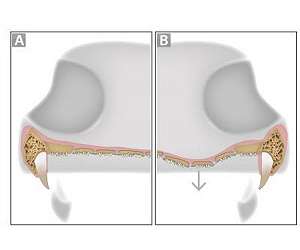
The idea of being bitten by a nearly toothless modern frog or salamander sounds laughable, but their ancient ancestors had a full array of teeth, large fangs and thousands of tiny hook-like structures called denticles on the roofs of their mouths that would snare prey, according to new research by paleontologists at the University of Toronto Mississauga (UTM). In research published online in a recent issue of PeerJ, an open access journal, Professor Robert Reisz, Distinguished Professor of Paleontology at UTM, explains that the presence of such an extensive field of teeth provides clues to how the intriguing feeding mechanism seen in modern amphibians was also likely used by their ancient ancestors. They believe that the tooth-bearing plates "were ideally suited for holding on to prey, such as insects or smaller tetrapods, may have facilitated a method of swallowing prey items via retraction of the eyeballs into the mouth, as some amphibians do today. In many vertebrates, ranging from fish to early synapsids (ancestors of mammals), denticles are commonly found in dense concentrations on the bones of the hard palate (roof of the mouth). However, in one group of tetrapods, temnospondyls (which are thought to be the ancestors of modern amphibians) these denticles were also found on small, bony plates that filled the large soft part of the palate. The entire roof of the mouth was covered with literally thousands of these tiny teeth that they used to grab prey. Since these toothy plates were suspended in soft tissue, they are often lost or scattered during fossilization. Denticles are significantly smaller than the teeth around the margin of the mouth - on the order of dozens to a couple hundred microns in length. They are actually true teeth, rather than just protrusions in the mouths of these tetrapods, says Reisz and his colleagues, Bryan Gee and Yara Haridy, both graduate students in paleontology. "Denticles have all of the features of the large teeth that are found on the margin of the mouth," says Reisz. "In examining tetrapod specimens dating back ~289 million years, we discovered that the denticles display essentially all of the main features that are considered to define teeth, including enamel and dentine, pulp cavity and peridontia." In reaching these conclusions, the researchers analyzed specimens unearthed from the fossil-rich Dolese Brothers Limestone Quarry near Richards Spur, Oklahoma. They were extraordinarily well preserved, making them ideal candidates for study. The researchers extracted and isolated the denticle-bearing plates, created thin section slides and examined them under the microscope - no small feat since denticles on this animal were only about 100 microns long. Reisz and his graduate students suggest that the next big question relates to evolutionary changes to the overall abundance of teeth: if these ancient amphibians had an astonishing number of teeth, why have most modern amphibians reduced or entirely lost their teeth?
 Volcanic carbon dioxide drove ancient global warming event
Southampton UK (SPX) Sep 04, 2017 New research, led by the University of Southampton and involving a team of international scientists, suggests that an extreme global warming event 56 million years ago was driven by massive CO2 emissions from volcanoes, during the formation of the North Atlantic Ocean. The study, published in Nature, used a combination of new geochemical measurements and novel global climate modelling to s ... read more Related Links University of Toronto Explore The Early Earth at TerraDaily.com

|
|||||||||||||
| The content herein, unless otherwise known to be public domain, are Copyright 1995-2026 - SpaceDaily. All websites are published in Australia and are solely subject to Australian law and governed by Fair Use principals for news reporting and research purposes. By using our websites you consent to cookie based advertising. If you do not agree with this then you must stop using the websites from May 25, 2018. Privacy Statement. Additional information can be found here at About Us. |

 del.icio.us
 Digg
Digg Reddit
 Google






