| . |  |
. |
| . | |
. |


 By Sara HUSSEIN Tokyo (AFP) Aug 12, 2020
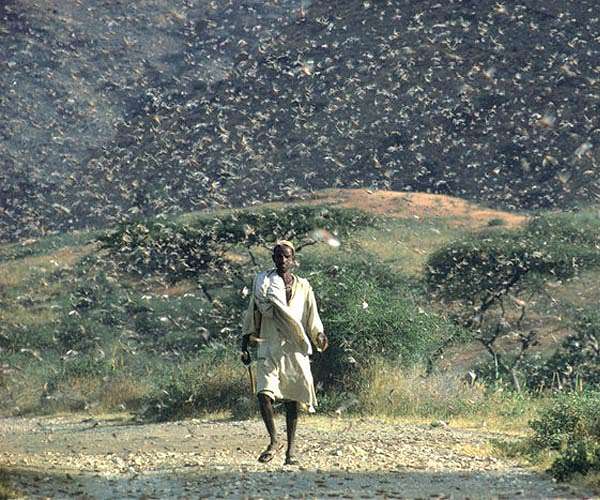
The coronavirus isn't the only plague making headlines this year -- locusts are devastating crops in several parts of the world, and now scientists are discovering why the pest forms destructive swarms. On its own, a locust is fairly harmless. But so-called solitary locusts can undergo a metamorphosis, changing colour and joining together with millions of others in catastrophic clouds that strip fields. So what prompts locusts to transform from solitary to "gregarious"? A study published Wednesday in the journal Nature reveals the secret lies in a pheromone. Almost like an irresistible perfume, the chemical compound is emitted by locusts when they find themselves in proximity to just a few others of their kind. The chemical attracts other locusts, who join the group and also begin emitting the scent, creating a feedback loop that results in enormous swarms. The discovery offers several tantalising possibilities, including genetically engineering locusts without the receptors that detect the swarming pheromone, or weaponising the pheromone to attract and trap the insects. The study comes as record numbers of locusts devour crops in east Africa and threaten the food supply in Pakistan. It focused on the migratory locust, the most widely distributed species of the insect, and examined several compounds produced by the bug. It found that one in particular -- 4-vinylanisole, or 4VA -- appeared to attract locusts when emitted, and that the more locusts flocked together, the more 4VA they emitted. The team, led by Le Kang, a professor at the Chinese Academy of Sciences, found solitary locusts began releasing 4VA when just four were placed together in a cage. The team then examined how the locusts picked up the scent, and isolated the part of the locust antennae responsible for detecting the swarming pheromone. And from there, they found the gene necessary for the detection process and produced genetically modified locusts lacking the key Or35 gene. The "mutant locusts lost their attraction to 4VA compared with the wild-type locusts", the study said. - Chemical interference - The discoveries open up several possibilities for tackling the voracious pests, including using genetic modification, or tracking 4VA production to predict where swarms may be forming. There are other avenues too, including weaponising the chemical, by using a synthetic form of it to bait traps to catch locusts. Kang and his team tried this, setting up traps in both controlled settings and in the field, and in both cases found the locusts were effectively lured. "Optimisation and adjustment are necessarily required from the experiments to practical application," Kang told AFP. But he said the traps were "significantly efficient" and could be a comparatively easy first application of the research. Leslie Vosshall, head of Rockefeller University's Laboratory of Neurogenetics and Behavior, said perhaps the most exciting application would be finding a chemical that would block reception of 4VA. "The discovery of such a molecule might provide a chemical antidote to insect aggregation and cause locusts to 'stand down' and return to their peaceful, solitary way of life," she wrote in a review commissioned by Nature. Vosshall pointed out that there are still several unknowns, including whether 4VA is the only thing that causes swarm formation, and whether other locust species respond similarly to the compound. Kang said genetic modification of locusts might offer "sustainable and green control" but acknowledged such a project would require large-scale and long-term efforts. "This is an approach for long-term control of locusts, and needs strict biological security evaluation before application."
Heavy rains kill 19 in Niger as locust swarm threatens Niamey (AFP) Aug 7, 2020 Heavy rains that have struck Niger since June have claimed 19 lives and inflicted economic harm on tens of thousands more, the government said on Friday, while the impoverished Sahel state faces a "major threat" of invasion by locusts. Of the 19 believed killed by the rains, 10 died by drowning and nine when homes collapsed, Niger's interior ministry said in a statement. Disaster management offices tallied some 6,215 households - or 53,000 people - that have suffered financial damage from the ... read more
|
|||||||||||||
| The content herein, unless otherwise known to be public domain, are Copyright 1995-2026 - SpaceDaily. All websites are published in Australia and are solely subject to Australian law and governed by Fair Use principals for news reporting and research purposes. By using our websites you consent to cookie based advertising. If you do not agree with this then you must stop using the websites from May 25, 2018. Privacy Statement. Additional information can be found here at About Us. |

 del.icio.us
 Digg
Digg Reddit
 Google







