| . |  |
. |
| . | |
. |


 by Staff Writers Amsterdam, Netherlands (SPX) Sep 21, 2018
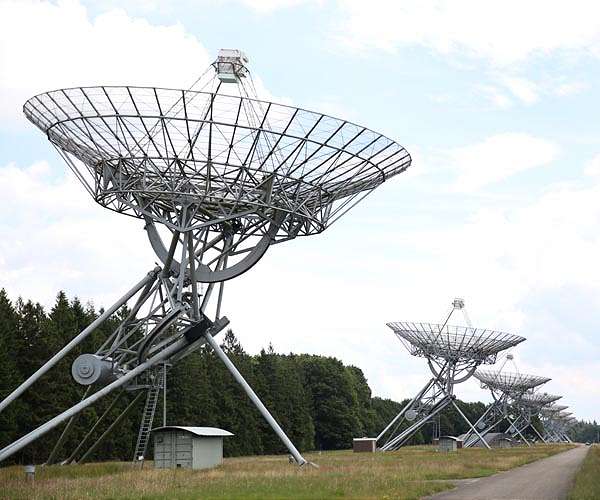
With an innovative new type of receiver, called Apertif, the field of view of the Westerbork Synthesis Radio Telescope in the Netherlands has been increased 37 times. Apertif, developed by the Netherlands Institute for Radio Astronomy (ASTRON), will be officially opened on 13 September 2018 by deputy Cees Bijl of the Drenthe province. On this day the 50-year anniversary of the telescope will also be celebrated. The iconic 50-year old Westerbork Synthesis Radio Telescope (WSRT) has been upgraded with a new high-speed, wide-field radio camera called Apertif. Using a technique called beamforming, 12 of the 14 dishes are now able to map a part of the sky that is 37 times larger than before. Apertif is also a pathfinder of the Square Kilometre Array (SKA), the future largest and most sensitive radio telescope in the world, recognised by the SKA project.
Evolution of galaxies It will also look at a smaller part of the sky in much more detail, giving us a sharper picture of very faint, nearby galaxies, as well as galaxies in the very distant Universe. These two surveys will lead to new insights into the formation and evolution of galaxies. The collected data will be used by future researchers for decades to come.
The exploding Universe Because the flashes last only a fraction of a second, they are very easy to miss and difficult to observe. This is going to change with Apertif, which will continuously make a high-speed movie of the radio sky that will be analysed by the most powerful GPU-supercomputer in the Netherlands.
Institute-wide effort "To develop a complex instrument such as Apertif, many people from multiple disciplines have to collaborate closely," says project leader Agnes Mika. "That's why engineers from different departments have been working together in one room for more than a year. This improved the communication and problem-solving significantly. I am very proud of the whole team, and happy to see Apertif become operational."

Success in Critical Communications Tests for NASA's James Webb Space Telescope Baltimore MD (SPX) Sep 07, 2018 When NASA's James Webb Space Telescope launches in 2021, it will write a new chapter in cosmic history. This premier space science observatory will seek the first stars and galaxies, explore distant planets around other stars, and solve mysteries of own solar system. Webb will be controlled from the Mission Operations Center (MOC) at the Space Telescope Science Institute in Baltimore, Maryland. To prepare for launch, the flight operations team recently conducted two successful communications tests ... read more
|
|||||||||||||
| The content herein, unless otherwise known to be public domain, are Copyright 1995-2026 - SpaceDaily. All websites are published in Australia and are solely subject to Australian law and governed by Fair Use principals for news reporting and research purposes. By using our websites you consent to cookie based advertising. If you do not agree with this then you must stop using the websites from May 25, 2018. Privacy Statement. Additional information can be found here at About Us. |

 del.icio.us
 Digg
Digg Reddit
 Google








