| . |  |
. |
| . | |
. |


 by Brooks Hays Washington (UPI) Jun 16, 2017
A team of MIT scientists have developed a battery that derives power from seawater. The technology promises to extend the range and capabilities of unpiloted underwater vehicles, or UUVs. Scientists spun the technology off into a startup company called Open Water Power. The company was recently acquired by L3 Technologies, an established tech firm. Most submersibles use lithium ion batteries, which are expensive to maintain and have a tendency to catch on fire. OWP's battery is cheaper, safer and longer-lasting. The batter consists of alloyed aluminum, a nickel-coated cathode and an alkaline electrolyte sandwiched between the electrodes. The battery's components require seawater to function. Seawater is sucked in and directed at the cathode, where it is split into hydroxide anions and hydrogen gas. A reaction between the anions and aluminum anode produces aluminum hydroxide and releases electrons. The electrons are drawn back toward the cathode, completing cycle. Harmless byproducts, aluminum hydroxide and hydrogen gas, are expelled into the ocean. Corroded aluminum anodes can be cheaply and easily replaced, prolonging the battery's lifespan. "Our power system can drink sea water and discard waste products," Ian Salmon McKay, one of the battery's inventors, told MIT. "But that exhaust is not harmful, compared to exhaust of terrestrial engines." Currently, the battery gives UUVs a range of 100 nautical miles. Engineers hope to eventually increase the battery's range to 1,000 nautical miles. The U.S. Navy recently hired OWP to replace the batteries powering acoustic sensors used to identify enemy submarines. The company's batteries could be used to power variety of underwater missions, whether military, industrial or scientific.
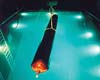 Boeing, Huntington Ingalls giving boost to Navy UUV program
Washington (UPI) Jun 8, 2017 Boeing and shipbuilder Huntington Ingalls Industries are partnering to design and build unmanned undersea vehicles in support of a U.S. Navy program. The teaming, which will leverage design and production facilities in California, Virginia and Florida, to expand the autonomous paradigm for UUV's for the Navy's Advanced Undersea Prototyping program. "This partnership provides the ... read more Related Links Water News - Science, Technology and Politics

|
|||||||||||||
| The content herein, unless otherwise known to be public domain, are Copyright 1995-2026 - SpaceDaily. All websites are published in Australia and are solely subject to Australian law and governed by Fair Use principals for news reporting and research purposes. By using our websites you consent to cookie based advertising. If you do not agree with this then you must stop using the websites from May 25, 2018. Privacy Statement. Additional information can be found here at About Us. |

 del.icio.us
 Digg
Digg Reddit
 Google






