| . |  |
. |
| . | |
. |


 by Staff Writers Bern, Switzerland (SPX) Feb 05, 2020
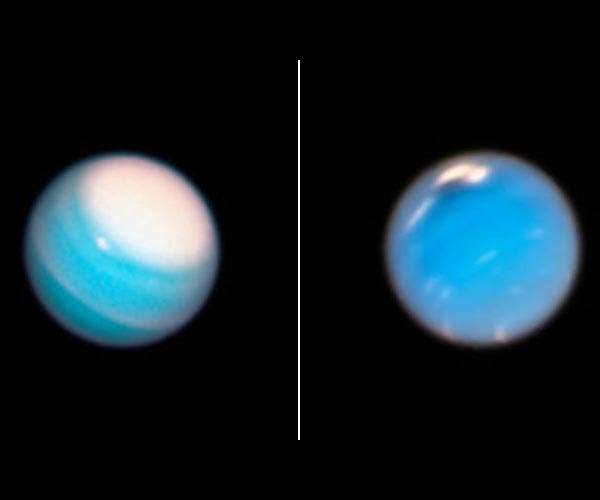
Uranus and Neptune are the outermost planets of the solar system. In size, possibly bulk composition, and their large distance from the Sun they are similar and clearly segregated from the inner terrestrial planets and the gas giants Jupiter and Saturn. "However, there are also striking differences between the two planets that require explanation," says Christian Reinhardt, who studied Uranus and Neptune together with Alice Chau, Joachim Stadel and Ravit Helled, all PlanetS members working at the University of Zurich, Institute for Computational Science. "For example, Uranus and its major satellites are tilted about 97 degrees into the solar plane and the planet effectively rotates retrograde with respect to the Sun." clarifies Joachim Stadel. Also, the satellite systems are different. Uranus' major satellites are on regular orbits and tilted with the planet, which suggests that they formed from a disk, similar to Earth's Moon. Triton instead, Neptune's largest satellite, is very inclined and therefore most likely a captured object. Finally, they could also be very different in terms of heat fluxes and internal structure.
Similar Formation - Different Collisions For the first time, the team of scientists at the University of Zurich investigated a range of different collisions on both planets using high resolution computer simulations. Starting with very similar pre-impact Uranus and Neptune they showed that an impact of a body with 1-3 Earth masses on both planets can explain this dichotomy. In the case of Uranus, a grazing collision can tilt the planet but does not affect the planet's interior. On the other hand, a head-on collision for Neptune strongly affects the interior but does not form a disk, and is therefore consistent with the absence of large moons on regular orbits. Such a collision, which remixes the deep interior, is supported by the larger observed heat flux of Neptune. "We clearly show that an initially similar formation pathway to Uranus and Neptune can result in the dichotomy observed in the properties of these fascinating outer planets," Ravit Helled summarizes. Future NASA and ESA missions to Uranus and Neptune can provide new key constraints on such a scenario, improve our understanding of the formation of the solar system, and provide a better understanding of exo-planets in this mass regime.
Research Report: "Bifurcation in the History of Uranus and Neptune: The Role of Giant Impacts"
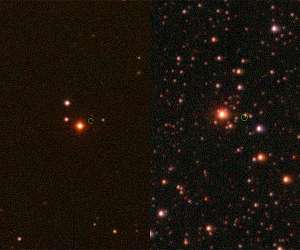
Seeing stars in 3D: The New Horizons Parallax Program Laurel MD (SPX) Jan 30, 2020 Have a good-sized telescope with a digital camera? Then you can team up with NASA's New Horizons mission this spring on a really cool - and record-setting - deep-space experiment. In April, New Horizons, which by then will be more than 46 times farther from the Sun than Earth, nearing 5 billion miles (8 billion kilometers) from home, will be used to detect "shifts" in the relative positions of nearby stars as compared with the way they appear to observers on Earth. The technique is called pa ... read more
|
|||||||||||||
| The content herein, unless otherwise known to be public domain, are Copyright 1995-2026 - SpaceDaily. All websites are published in Australia and are solely subject to Australian law and governed by Fair Use principals for news reporting and research purposes. By using our websites you consent to cookie based advertising. If you do not agree with this then you must stop using the websites from May 25, 2018. Privacy Statement. Additional information can be found here at About Us. |

 del.icio.us
 Digg
Digg Reddit
 Google






