| . |  |
. |
| . | |
. |


 by Katrina Cabansay for UCF News Orlando FL (SPX) Oct 27, 2022
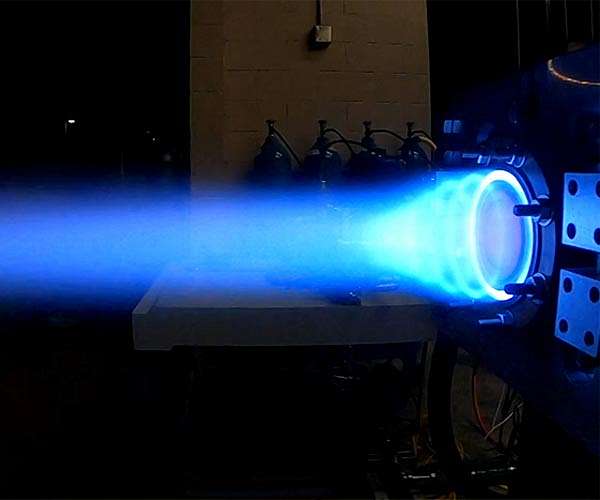
A University of Central Florida researcher has received NASA funding to further develop a novel rocket engine system that could revolutionize space travel. The project focuses on rotating detonation rocket engines (RDREs), which are powered by continuous Mach 5 explosions that rotate around the inside of the engine and are sustained by hydrogen and oxygen propellants fed into the system in certain amounts. NASA recently awarded $50,000 to fund the project. Mach 5 explosions create bursts of energy that travel 4,500 to 5,600 miles per hour, which is more than five times the speed of sound. By using these high-energy detonations, more energy can be generated with less fuel, improving engine efficiency and cutting down space travel costs and emissions. Kareem Ahmed, the lead researcher of the project and associate professor in UCF's Department of Mechanical and Aerospace Engineering, has been researching RDREs for years. Ahmed and his team have already published a study with evidence that this type of engine works and are using the NASA award to work on an RDRE replacement for the RL10 engine, which currently powers many space flights including the upcoming Artemis missions. "We have demonstrated the technology, now it is time for the development," Ahmed says. RL10 engine variants are used in many launchers such as the Atlas V, Vulcan, and Orbital ATK OmegA. Seeing as the U.S. government is the largest user of launch services in the world, advancing lower-cost, high-performance RDRE technology will lead to significant cost savings, Ahmed says. RDREs could also be used for commercial purposes, facilitating new markets such as widespread satellite-based high-speed internet services due to reduced launch costs. Multiple federal agencies such as NASA, the Department of Defense, the National Reconnaissance Office, and the National Oceanic and Atmospheric Administration depend on satellites for their basic functions. If expanded to other transportation methods like planes, RDREs could even allow for coast-to-coast travel in under thirty minutes and five-minute flights from New York to London. The project was one of twelve proposals selected for NASA's 2022 M-STTR grant, which seeks to promote partnerships between Minority-Serving Institutions and small businesses in preparation for them to send proposals to NASA's annual STTR Phase I solicitation. Ahmed and his team partnered with small business Creare LLC as well as Halo LLC with Aerojet Rocketdyne for the technology transition.
Ahmed earned his doctoral degree in mechanical engineering from the University at Buffalo - The State University of New York. He worked at Pratt and Whitney Military Engines and Old Dominion University prior to joining UCF's Department of Mechanical and Aerospace Engineering, part of UCF's College of Engineering and Computer Science, in 2015. He is the director of UCF's Propulsion and Energy Research Laboratory, a faculty member of UCF's Center for Advanced Turbomachinery and Energy Research, an associate fellow of the American Institute of Aeronautics and Astronautics, and an AFRL Faculty Research Fellow

Gilmour Space partners with Equipmake on advanced motors for rocket program Gold Coast, Australia (SPX) Oct 25, 2022 Global electrification specialist Equipmake has been selected by Australia's leading space company, Gilmour Space Technologies, to support its commercial space rocket programme with the supply of advanced electric motors and inverters. Led by former F1 engineer Ian Foley, Equipmake has forged its reputation by developing advanced EV technology for automotive OEMs and specialist supercar manufacturers, offering a complete suite of solutions from electric motors to power electronic systems to comple ... read more
|
|||||||||||||
| The content herein, unless otherwise known to be public domain, are Copyright 1995-2026 - SpaceDaily. All websites are published in Australia and are solely subject to Australian law and governed by Fair Use principals for news reporting and research purposes. By using our websites you consent to cookie based advertising. If you do not agree with this then you must stop using the websites from May 25, 2018. Privacy Statement. Additional information can be found here at About Us. |

 del.icio.us
 Digg
Digg Reddit
 Google






