| . |  |
. |
| . | |
. |


Towards Mysterious Mercury
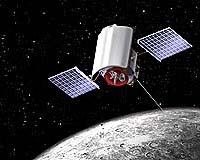
Moffett Field CA (SPX) Aug 04, 2004 The Messenger spacecraft launched successfully at 2:16 a.m. EDT, as the weather in Cape Canaveral, Florida finally cooperated. Messenger (MErcury Surface, Space ENvironment, GEochemistry, and Ranging) will be the first spacecraft to visit the planet Mercury since the Mariner 10 mission in 1974. Sean Solomon, Messenger Principal Investigator from the Carnegie Institution of Washington, says that by studying Mercury, we will gain a better understanding of terrestrial planets. Mercury, Mars, Venus and the Earth all formed from the gas and dust of the solar nebula. "They formed by the same processes, they formed at the same time. Their outcomes were extremely different," says Solomon. "Mercury is the most extreme of the four planets. Besides being closet to the sun, it is the most dense, with the highest variation in temperature on its surface, and of course it's the smallest of the four." Because Mercury is so close to the sun, its surface temperature can exceed 450 degrees Celsius (840 degrees Fahrenheit). But Mercury is not uniformly hot, because the thin atmosphere does not transfer heat from the equator to the poles. Temperatures on the dark side of the planet can drop to -185 degrees C (-300 degrees F). Messenger carries seven scientific instruments that will provide images of the entire planet, as well as information on the composition of Mercury's crust, core, and polar materials, its geologic history, and the nature of its thin atmosphere and active magnetosphere. "(Messenger will answer) a host of questions, all of which will illuminate how different Mercury is from the rest of the inner planets, and by virtue of those differences, will tell us a lot more of how Earth-like planets are assembled in general," says Solomon. Mercury is about the size of our moon, and extremely dense. The planet's density is so high that two-thirds of the planet is believed to be iron metal. For this reason, Mercury's surface gravity is about the same as the surface gravity of Mars. Scientists aren't sure why Mercury is so dense. Perhaps there was a gradient in chemistry of the solar disk of gas and dust that formed the planets, with more metal closer to the sun. Solomon says that if Mercury's high iron composition is due to a solar nebula gradient, then the silicate material at Mercury's surface should have the major elements in approximately solar proportions. Another possibility is that Mercury's composition was Earth-like to start, but the heat from the sun caused Mercury to lose its rocky material. If so, then the surface will have relatively less of the more easily vaporized materials. When Mariner 10 flew by Mercury in 1974 and 1975, it took pictures of less than half of the planet's surface. Still, these images allowed scientists to see Mercury's surface close-up, revealing a moon-like landscape dotted with craters. Because the spin axis of Mercury has almost no tilt, some of these craters remain in permanent shadow. The floors of the craters are highly reflective at radar wavelengths. This could indicate frozen water, but any volatile with a freezing point above -180 degrees C also could cause this reflectivity. Mariner images also showed large-scale faulting on the planet's surface. Scarps scattered randomly over the hemisphere are a result of the crust buckling, and suggest that the planet has shrunk from its original size. "(That) seems a little crazy at first, but when you think about it, as the core cooled, when it goes from a liquid to a solid there's going to be a volume change," says Mark Robinson, Messenger investigator from Northwestern University. "If the crust had already formed when that happened, as the planet shrank, that tension had to be taken up somewhere, and buckling of the crust made these large scarps." Mariner 10 also discovered that Mercury has a magnetic field very similar to Earth's. Earth's magnetic field results from a dynamo mechanism arising from a fluid outer core. Mercury also could have a fluid outer core, although models suggest that Mercury's core should have solidified before now. "The mystery is why has tiny Mercury retained a magnetic field, when larger planets in the inner solar system - Mars and Venus - do not have a global magnetic field today," says Solomon. Earth's core contains elements other than iron, and this depresses the melting point, allowing the outer core to remain liquid longer. Mercury's core also could have elements that lower the melting point. According to Robert Strom, Messenger co-Investigator from the University of Arizona in Tucson, Mariner 10 was designed to be a reconnaissance orbiter that would allow scientists to characterize Mercury enough to design a planetary orbiter. This planetary orbiter was projected to launch around 1980, but instead it has taken 30 years to move from the reconnaissance to the orbiter stage. After launch, Messenger will have a long looping journey through the solar system. It will use six gravity-assist maneuvers: one by Earth, two by Venus, and three by Mercury. Messenger's first flyby of Mercury will be in 2008, and it will enter Mercury's orbit in March 2011. Messenger will travel 7.9-billion kilometers (4.9-billion miles), orbiting around the sun 15 times. This long journey will allow the mostly solar-powered Messenger to carry much less fuel than it would need for a more straightforward path. Messenger will orbit Mercury for at least one Earth year. Yet during that time, only two days will have passed on Mercury. Mercury has a slow rotation rate, and orbits the sun twice before it completes a single spin. One Mercury solar day, from sunrise to sunrise, is equal to 176 Earth days. Messenger will complete an elliptical orbit around Mercury every 12 hours. The orbit will be highly inclined, measuring 80 degrees from the equator, and will most closely approach Mercury's northern hemisphere. The lowest altitude planned is 200 kilometers (124 miles). The sun is 11 times hotter at Mercury than it is at Earth, so Messenger is equipped with a heat shield to protect the spacecraft instruments. The sun is dynamic, with 11-year cycles of minimum and maximum activity. Explosive solar flares and coronal mass ejections (CMEs), which have been known to disrupt electronics on Earth, could jeopardize Messenger. The spacecraft was designed with this in mind, but Solomon admits that a CME could severely disrupt the electronics onboard Messenger. "We're just going to have to take our chances - which are pretty good - that any such activity would miss our spacecraft," says Solomon. The end of the Messenger mission will coincide with a period of maximum solar activity. Solar flares and CMEs can happen any time in the Sun's 11-year cycle, but they're particularly plentiful during solar maximum. "We're not like Cassini, going out where it's nice and cool," says Strom. "Orbiters of Mars and Jupiter and Saturn, they're kind of orbiting paradise compared to Messenger, which is going to orbit hell. But it's a very interesting hell." Related Links SpaceDaily Search SpaceDaily Subscribe To SpaceDaily Express
 The Long and Winding Road
 Kennedy Space Center FL (SPX) Aug 04, 2004
Point your spacecraft in the right direction to pass by the planet as it orbits the Sun, and get whatever information you can during the high-speed rendezvous. That was NASA's strategy during the early days of Solar System exploration, and it provided us with an incredible amount of insight into our universe. |
|
|

| The content herein, unless otherwise known to be public domain, are Copyright 1995-2006 - SpaceDaily.AFP and UPI Wire Stories are copyright Agence France-Presse and United Press International. ESA PortalReports are copyright European Space Agency. All NASA sourced material is public domain. Additionalcopyrights may apply in whole or part to other bona fide parties. Advertising does not imply endorsement,agreement or approval of any opinions, statements or information provided by SpaceDaily on any Web page published or hosted by SpaceDaily. Privacy Statement |