| . |  |
. |
| . | |
. |


The Long and Winding Road
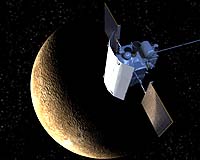
Kennedy Space Center FL (SPX) Aug 04, 2004 Point your spacecraft in the right direction to pass by the planet as it orbits the Sun, and get whatever information you can during the high-speed rendezvous. That was NASA's strategy during the early days of Solar System exploration, and it provided us with an incredible amount of insight into our universe. The difficulty level gets turned up a notch when talking about "orbital insertion." You're not just flying by the planet; you're getting there and then slowing down to the point where the world that you want to explore pulls your spacecraft into orbit around it. Too slow and your probe will drop into the planet's atmosphere and burn up. Too fast and you'll fly off into space, stuck helpless in a solar orbit for billions of years. NASA's Messenger will head into space with all the energy and speed it had when it left the Earth, and then have to slow down to meet up with Mercury. This means Messenger has to burn off a lot of energy during its journey. One way is to carry a large amount of fuel and perform braking maneuvers during the trip. But fuel already accounts for more than half of Messenger's total launch weight; adding more would weigh down the spacecraft to the point where it wouldn't be practical to launch at all. The other technique, which Messenger is going to undertake on its journey, is called "gravity assist." Most people think of speeding up a spacecraft when they hear about this concept, but it can actually work to slow one down as well. This is due to "angular momentum," the tremendous amount of energy a planet orbiting the Sun has because of its enormous size and speed. When a spacecraft flies past that giant body, it can tap into the planet's gravity to increase its speed. When a spacecraft flies along in front of it, the opposite happens: the vehicle gives up some of its energy to the planet. NASA's Messenger will fly by Earth, Venus and Mercury several times to burn off energy before making its final approach to the inner planet on March 18, 2011. Related Links SpaceDaily Search SpaceDaily Subscribe To SpaceDaily Express
 Towards Mysterious Mercury
 Moffett Field CA (SPX) Aug 04, 2004
The Messenger spacecraft launched successfully at 2:16 a.m. EDT, as the weather in Cape Canaveral, Florida finally cooperated. Messenger (MErcury Surface, Space ENvironment, GEochemistry, and Ranging) will be the first spacecraft to visit the planet Mercury since the Mariner 10 mission in 1974. |
|
|

| The content herein, unless otherwise known to be public domain, are Copyright 1995-2006 - SpaceDaily.AFP and UPI Wire Stories are copyright Agence France-Presse and United Press International. ESA PortalReports are copyright European Space Agency. All NASA sourced material is public domain. Additionalcopyrights may apply in whole or part to other bona fide parties. Advertising does not imply endorsement,agreement or approval of any opinions, statements or information provided by SpaceDaily on any Web page published or hosted by SpaceDaily. Privacy Statement |