|
 |
 |
 |
 |
 |
 |
 |
 |
 |

| . |  |
. |
Telesat Buys LockMart Bird And Launch Package
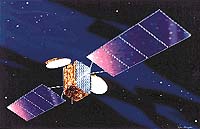
Sunnyvale - June 2, 2001 Lockheed Martin Commercial Space Systems (LMCSS) today announced the award of a contract from Telesat Canada to build an A2100 geosynchronous satellite, with launch on an Atlas V rocket provided by International Launch Services (ILS), backed up by a Proton. The Ku/Ka-band satellite, designated Nimiq 2, will provide direct broadcast services across Canada following its scheduled launch in the fourth quarter of 2002. The satellite represents the fourth new order of the year for Commercial Space Systems from several customers. "Today's announcement of plans for Nimiq 2 is yet another sign that Telesat is aggressively expanding its satellite fleet for the future," said Larry Boisvert, Telesat's president and CEO. "The launch of Telesat's second direct broadcast satellite will enable the continued growth of our business. We're very pleased to work with Lockheed Martin and ILS -- our partners on the launch of the historic Nimiq 1 satellite in 1999." Nimiq 2, a high power Ku/Ka-band satellite, will be located at 91 degrees West longitude. The spacecraft features 32 active 24 MHz Ku-band transponders with 120 watt power amplifiers, and also has a Ka-band payload that will provide broadband services. Nimiq 2 will be an A2100AX satellite, manufactured by Lockheed Martin Commercial Space Systems, with a minimum service life of 12 years. "We are extremely pleased that Telesat has selected Lockheed Martin to provide the Nimiq 2 direct broadcast satellite and the Atlas V rocket," said Ted Gavrilis, president, Lockheed Martin Commercial Space Systems. Nimiq I is also an A2100 series satellite manufactured by Lockheed Martin and has been providing direct-to-home satellite television to consumers across Canada since 1999. "Telesat is a valued customer and we are honored that another A2100 spacecraft will serve their growing business," added Gavrilis. "ILS launched the first Nimiq satellite on a Proton in May 1999, and we welcome the opportunity to launch Nimiq 2 on an Atlas V," said ILS President Mark Albrecht. "Having repeat business means customers are confident we'll provide reliable launch vehicles and dependable schedules." ILS manages launches on both the Lockheed Martin-built Atlas vehicles and the Proton rockets built by Khrunichev of Russia. The first vehicle in the high-performance Atlas V series has been built by Lockheed Martin Space Systems in Denver, and was recently shipped to Cape Canaveral, Fla. It will be ready for launch in the second quarter of 2002. The Atlas V family is designed to lift payloads from 4900 kg to nearly 8700 kg to geosynchronous transfer orbit (GTO). It incorporates state-of-the-art designs, materials and processes, including the throttleable, Russian-built RD-180 engine, the first variable-thrust main engine to power a U.S. expendable launch vehicle. The RD-180 and most of the other technologies for Atlas V were flight-proven last year, during ILS' successful initial launch of the Atlas III rocket. The A2100 geosynchronous spacecraft is designed to meet a wide variety of telecommunications needs ranging from Ka band/broadband services, fixed satellite services in a hybrid Ku- and C-band payload configuration, to high-power direct broadcast services using the Ku-band frequency spectrum. The A2100's modular design features a reduction in parts, simplifying construction, increasing on-orbit reliability and reducing weight and cost. Related Links Telesat Lockheed Martin Commercial Space Systems International Launch Services SpaceDaily Search SpaceDaily Subscribe To SpaceDaily Express
 Cellular Grab For 2Ghz Harms Rural Satellite Consumers: SIA Report
 Alexandria - May 29, 2001
The Satellite Industry Association (SIA) and Satellite Broadcasting and Communications Association (SBCA) today announced their opposition to a petition for rulemaking filed with the Federal Communications Commission (FCC) by Cellular Telecommunications & Internet Association (CTIA). |
|
|

| The content herein, unless otherwise known to be public domain, are Copyright 1995-2006 - SpaceDaily.AFP and UPI Wire Stories are copyright Agence France-Presse and United Press International. ESA PortalReports are copyright European Space Agency. All NASA sourced material is public domain. Additionalcopyrights may apply in whole or part to other bona fide parties. Advertising does not imply endorsement,agreement or approval of any opinions, statements or information provided by SpaceDaily on any Web page published or hosted by SpaceDaily. Privacy Statement |