| . |  |
. |
| . | |
. |


 by Staff Writers Bremen, Germany (SPX) Dec 29, 2022
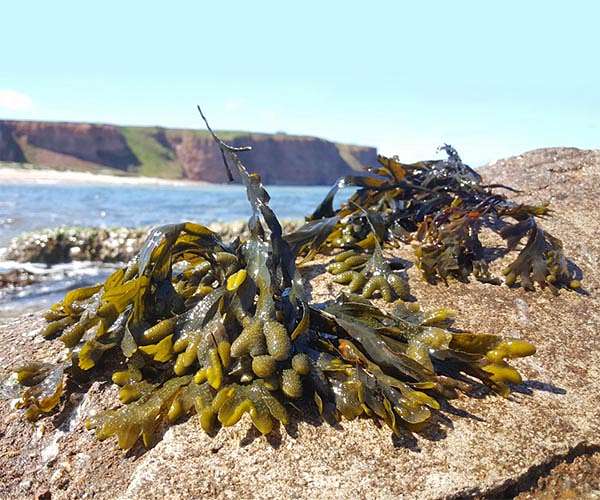
Brown algae are true wonder plants when it comes to absorbing carbon dioxide from the air. They even outcompete forests on land in this, and thus play a decisive role for the atmosphere and our climate. But what happens to the carbon dioxide after the algae have absorbed it? Researchers at the Max Planck Institute for Marine Microbiology now report in the Proceedings of the National Academy of Sciences (PNAS) that the brown algae can remove large amounts of carbon dioxide from the global cycle in the long term and thus can counteract global warming.
Fucoidan: Brown algae slime is not a favourite dish "The excretions of brown algae are very complex and therefore incredibly complicated to measure," says first author Hagen Buck-Wiese from the Max Planck Institute for Marine Microbiology in Bremen. "However, we have managed to develop a method to analyse them in detail." With this method, the researchers scrutinised a large number of different substances. The so-called fucoidan turned out to be particularly exciting. "Fucoidan made up about half of the excretions of the brown algae species we studied, the so-called bladderwrack," says Buck-Wiese. Fucoidan is a recalcitrant molecule. "The fucoidan is so complex that it is very hard for other organisms to use it. No one seems to like it." As a result, the carbon from the fucoidan does not return to the atmosphere quickly. "This makes the brown algae particularly good helpers in removing carbon dioxide from the atmosphere in the long term - for hundreds to thousands of years."
Brown algae could bind almost all of Germany's carbon dioxide emissions For comparison: Germany's annual greenhouse gas emissions currently amount to about 0.74 gigatons of carbon dioxide, according to the Federal Environment Agency (Umweltbundesamt, estimation for 2020). "And even better: The fucoidan does not contain any nutrients such as nitrogen," Buck-Wiese explains further. Thus, the growth of the brown algae is not affected by the carbon losses.
More species and sites "Next we want to look into other brown algae species and other locations," says Buck-Wiese. "The great potential of brown algae for climate protection definitely needs to be further researched and utilised."
Research Report:Fucoid brown algae inject fucoidan carbon into the ocean
2022 UK's hottest year on record: provisional Met Office figures London (AFP) Dec 28, 2022 This year is set to be the UK's warmest on record, according to provisional figures released by the Met Office on Wednesday. It had the "highest annual average temperature across the UK, exceeding the previous record set in 2014 when the average was 9.88 degrees Celsius (49.78 degrees Fahrenheit)", the Met said in a statement. The figure for 2022 would be announced later. Since 1884, each of the ten years recording the highest annual temperature have occurred from 2002, according to the for ... read more
|
|||||||||||||
| The content herein, unless otherwise known to be public domain, are Copyright 1995-2026 - SpaceDaily. All websites are published in Australia and are solely subject to Australian law and governed by Fair Use principals for news reporting and research purposes. By using our websites you consent to cookie based advertising. If you do not agree with this then you must stop using the websites from May 25, 2018. Privacy Statement. Additional information can be found here at About Us. |

 del.icio.us
 Digg
Digg Reddit
 Google







