| . |  |
. |
| . | |
. |


 by Staff Writers San Antonio TX (SPX) Dec 27, 2022
NASA's Juno spacecraft completed its 47th close pass of Jupiter on Dec. 14. Afterward, as the solar-powered orbiter was sending its science data to mission controllers from its onboard computer, the downlink was disrupted. The issue - an inability to directly access the spacecraft memory storing the science data collected during the flyby - was most likely caused by a radiation spike as Juno flew through a radiation-intensive portion of Jupiter's magnetosphere. Mission controllers at NASA's Jet Propulsion Laboratory and its mission partners successfully rebooted the computer and, on Dec. 17, put the spacecraft into safe mode, a precautionary status in which only essential systems operate. As of Dec. 22, steps to recover the flyby data yielded positive results, and the team is now downlinking the science data. There is no indication that the science data through the time of closest approach to Jupiter, or from the spacecraft's flyby of Jupiter's moon Io, was adversely affected. The remainder of the science data collected during the flyby is expected to be sent down to Earth over the next week, and the health of the data will be verified at that time. The spacecraft is expected to exit safe mode in about a week's time. Juno's next flyby of Jupiter will be on Jan. 22, 2023.
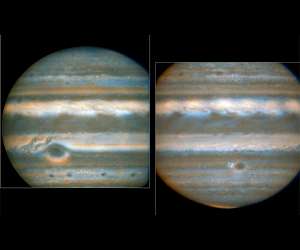
Four decade study finds mysterious patterns in temperatures at Jupiter Pasadena CA (JPL) Dec 20, 2022 Scientists have completed the longest-ever study tracking temperatures in Jupiter's upper troposphere, the layer of the atmosphere where the giant planet's weather occurs and where its signature colorful striped clouds form. The work, conducted over four decades by stitching together data from NASA spacecraft and ground-based telescope observations, found unexpected patterns in how temperatures of Jupiter's belts and zones change over time. The study is a major step toward a better understanding of what ... read more
|
|||||||||||||
| The content herein, unless otherwise known to be public domain, are Copyright 1995-2026 - SpaceDaily. All websites are published in Australia and are solely subject to Australian law and governed by Fair Use principals for news reporting and research purposes. By using our websites you consent to cookie based advertising. If you do not agree with this then you must stop using the websites from May 25, 2018. Privacy Statement. Additional information can be found here at About Us. |

 del.icio.us
 Digg
Digg Reddit
 Google






