| . |  |
. |
| . | |
. |


 by Staff Writers Osaka, Japan (SPX) Jul 14, 2017
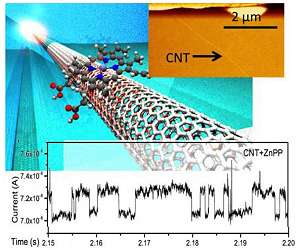
Noise is low-frequency random fluctuation that occurs in many systems, including electronics, environments, and organisms. Noise can obscure signals, so it is often removed from electronics and radio transmissions. The origin of noise in nanoscale electronics is currently of much interest, and devices that operate using noise have been proposed. Materials with a high surface-to-volume ratio are attractive for studying the noise produced by nanoscale electronics because they are very sensitive to changes of their surfaces. A representative material of this type is carbon nanotubes, which are rolled sheets of the graphene hexagonal network, which is only one carbon atom thick. A Japanese collaboration led by Osaka University has explored the ability of single molecules to affect the noise generated by carbon nanotube-based nanoscale electronic devices. The team fabricated simple devices consisting of a carbon nanotube bridging two electrodes. The devices were exposed to different large molecules, causing some to bind to the carbon nanotube surface. It was found that different molecules gave unique noise signals related to the properties of the molecules. The strength of the interaction between the carbon nanotubes and molecules was able to be predicted from the obtained noise signals. "The signal generated by the carbon nanotube device changed following the adsorption of specific single molecules," says first author Agung Setiadi. "This is because the adsorbed molecule generated a trap state in the carbon nanotube, which changed its conductance." What this means is that the carbon nanotube-based devices were so sensitive that the researchers were able to detect unique signature from single molecules. The ability to characterize single molecules using highly sensitive nanoelectronics is an exciting prospect in the field of sensors, particularly for neuro- and biosensor applications. "Use of noise signals to identify molecular activity ((interaction) or (active orbital)) is attractive for developing advanced sensing devices," explains corresponding author Megumi Akai-Kasaya. "We demonstrated that noise can be exploited to improve the signal detection ability of a device." The results of this successful demonstration will be published in the near future in a follow-up article. Signal detection sensitivity may be increased through controllable noise generation. These carbon nanotube-based devices illustrate that it is possible to detect single molecules through their unique noise signatures in the device current signals. Improved knowledge of the molecular-level origin of noise should lead to the development of electronics that use noise to improve their performance rather than degrade it.
 Long Duration Experiments Reach 1,000th Day
London, Uk (Spx) Jul 07, 2017 The first experiment placed on Diamond's Long Duration Experimental (LDE) facility, on beamline I11, has now been in place for 1,000 days. The experiment, led by Dr Claire Corkhill from the University of Sheffield, has used the world-leading capabilities of the beamline to investigate the hydration of cements used by the nuclear industry for the storage and disposal of waste. "Understandin ... read more Related Links Osaka University Space Technology News - Applications and Research

|
|||||||||||||
| The content herein, unless otherwise known to be public domain, are Copyright 1995-2026 - SpaceDaily. All websites are published in Australia and are solely subject to Australian law and governed by Fair Use principals for news reporting and research purposes. By using our websites you consent to cookie based advertising. If you do not agree with this then you must stop using the websites from May 25, 2018. Privacy Statement. Additional information can be found here at About Us. |

 del.icio.us
 Digg
Digg Reddit
 Google





