| . |  |
. |
| . | |
. |


 By Patrick GALEY Paris (AFP) March 17, 2021
Sea bed bottom trawling produces as much as one billion tonnes of carbon annually -- equivalent to all emissions from aviation -- according to new research that called Wednesday for greater ocean protections. The ocean floor contains twice as much carbon as all of Earth's soil, which is disturbed and emitted when fishing boats dredge their nets along it. Authors of the study said that protecting specific areas where bottom trawling is prolific could save emissions and help support global fish stocks. Ocean biodiversity is in precipitous decline due to overfishing, pollution and climate change. Yet only seven percent of oceans are under any form of protection. The study, published in the journal Nature, analysed maps of sea floor carbon stocks along with satellite data of bottom trawling to estimate how much carbon is emitted from the practice each year. They found that the amount of carbon released was equivalent to more than one gigatonne of carbon dioxide (CO2) emissions. That is more than the emissions of any country apart from China, the US, India, Russia and Japan, the authors said. But, by prioritising protected areas for parts of the sea that are owned by countries, they said that protecting just 3.6 percent of the ocean could help eliminate the carbon emission risk from dredging by 90 percent. "The ocean floor is the world's largest carbon storehouse. If we're to succeed in stopping global warming, we must leave the carbon-rich seabed undisturbed," said co-author Trisha Atwood of Utah State University. "Yet every day, we are trawling the seafloor, depleting its biodiversity and mobilising millennia-old carbon and thus exacerbating climate change." If countries worked together to protect 45 percent of the ocean, it would bestow a 71 percent benefit in terms of biodiversity preservation, the study said. Since much of the most biodiverse ocean currently sits within countries' Exclusive Economic Zones (EEZ), the authors argued that international cooperation was needed to protect sea life. "Perhaps the most impressive and encouraging result is the enormous gain we can obtain for biodiversity conservation -- if we carefully chose the location of strictly protected marine areas," said David Mouillot, co-author and a professor at the University of Montpellier. - Oceans 'overlooked' - In addition, the study found that strategically banning fishing from specific areas could increase global fish yields by as much as eight million tonnes compared to business as usual. Boris Worm, study co-author and Killam Research Professor at Dalhousie University in Halifax, Nova Scotia, said the research highlighted the crucial role that the ocean can play in mitigating climate change and preserving nature. "The ocean covers 70 percent of the earth -- yet, until now, its importance for solving the challenges of our time has been overlooked," he said. "If we want to solve the three most pressing challenges of our century -- biodiversity loss, climate change and food shortages -- we must protect our ocean."
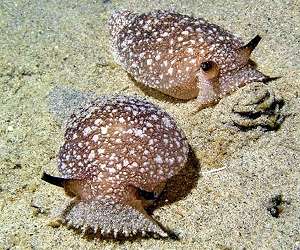
Some sea slugs sever their own heads, grow whole new bodies Washington DC (UPI) Mar 8, 2021 For at least two species of sea slug, decapitation is no big deal. After purposefully severing its head, a sacoglossan sea slug can regrow its entire body, heart and all. Scientists observed the phenomenon - detailed Monday in the journal Current Biology - while studying the development of the marine invertebrates, from eggs to adult sea slugs. In the lab, researchers noticed the head of a sacoglossan sea slug moving around without its body. "We were surprised to see the head mo ... read more
|
|||||||||||||
| The content herein, unless otherwise known to be public domain, are Copyright 1995-2026 - SpaceDaily. All websites are published in Australia and are solely subject to Australian law and governed by Fair Use principals for news reporting and research purposes. By using our websites you consent to cookie based advertising. If you do not agree with this then you must stop using the websites from May 25, 2018. Privacy Statement. Additional information can be found here at About Us. |

 del.icio.us
 Digg
Digg Reddit
 Google







