| . |  |
. |
| . | |
. |


Sandia Underground Geo-Tools Aid In Earthquake Research
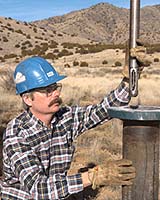
Albuquerque NM (SPX) Mar 08, 2005 Geothermal researchers at Sandia National Laboratories have developed sensors that can be placed in hotter and higher-pressure underground environments than previous instruments, a capability that is allowing geologists worldwide to make more precise measurements of subterranean conditions before and after large earthquakes occur. The researchers hope the new sensors will provide geologists with a better understanding of earthquake-related phenomena and possibly provide more sensitive measurements of warning signs for large earthquakes such as the devastating 9.0 magnitude earthquake near Sumatra on Sunday, Dec. 26.
Extremely accurate Lab engineers Joe Henfling and Randy Normann with technologist David Chavira are building a series of increasingly resilient and sensitive instruments that are being used by the U.S. Geological Survey and others to study a number of earthquake-related phenomena. Sandia engineers, who have worked for decades with the geothermal resources experts around the U.S., have gained a reputation for building reliable instruments that can operate in the high-temperature and high-pressure environments of a geothermal reservoir, explains Normann. Sandia-designed instruments continue to push the envelope to provide scientists with better data, he says. Using Quartzdyne quartz pressure and temperature sensors with a relative resolution of less than 0.005 psi and .01 degree C makes the instruments extremely accurate, Normann says. "We can monitor extremely small temperature and pressure changes in deep reservoirs," he says. Sandia began working with the USGS two years ago on a program to monitor geothermal wells, which contain water in the pore spaces between grains in the hot rock. Using pressure and temperature tools to analyze earthquake data shows potential because reservoirs can sometimes be five to 10 miles long, creating a much larger area of sensitivity to the waves generated by quakes than the relatively small area used by seismic detectors. "We also have the potential to put tools much deeper in hotter zones below the reservoir where the rock is over 200 degrees C," says Normann. California's Long Valley is one of several places where distant earthquakes are registered through a phenomenon called remotely triggered seismicity, says Evelyn Roeloffs, a Vancouver, Wash.-based USGS geophysicist. Large earthquakes, sometimes far away, create waves that cause bursts of micro-earthquakes in the area. Some persist for days after other seismic activity has returned to normal. "We have a history of monitoring in Long Valley," she says. "In the past, we couldn't record the pressures frequently enough to determine if there was any response to seismic activity. Now we are recording temperatures and pressures once every 2.5 seconds. "We want to see if we can get better timing of the pressure changes in the rock relative to the seismic activity and if there are temperature changes." Sometimes pressures in the fluids in the reservoirs increase after earthquakes and movements in the rocks can be measured. "If we could put tools in deeper and hotter wells, we could get better information," Roeloffs says.
Drilling deeper At New Mexico Tech in Socorro, geophysicist Harold Tobin is also discussing a deeper and hotter regime for the placement of Sandia's geothermal tools. "We are still in the planning stages, but in about a year and a half we are going to start a big drilling project to bore into a tectonic feature similar to the one where the Sumatra earthquake occurred," says the associate professor. "The site is off the coast of Japan in the Nankai Trough Seismogenic Zone. The target is six kilometers (3.6 miles) beneath the ocean's floor in water two kilometers (1.2 miles) deep, in a subduction zone where some of the largest earthquakes on the planet have been generated. In 1944 and again in 1946 the quakes generated significant tidal waves, or tsunamis, as well. "We are looking to place instruments in the fault zone to better understand the precursors of earthquakes and to learn about the physics of these zones in terms of storing stress and releasing it as the plates slip and displace," he says. "We will need instruments that can withstand temperatures of 150 to 180 C, which are well up in the range where normal electronics don't work." Basically, scientists understand that the friction between two moving rock faces causes them to stick and build up pressure until it overcomes the friction, moving the rock and creating an earthquake. "There's a theory that the pore fluid pressure in the rocks affects this dynamic," Tobin says. High water pressure may push faces apart, allowing slippage of the rock faces. "When earthquakes happen may be governed by fluid pressure, which is why the instruments down hole are so important," he says.
Going barefoot The secret to Sandia's success in designing robust high-temperature tools is in part a material called Silicon-on-Insulator (SOI), which isolates the transistors from one another and greatly reduces thermally generated current leaks that occur on normal silicon-designed components, says Normann. With silicon-based electronics, the resistance of the silicon material breaks down as heat increases and it begins to act increasingly like a conductor of electricity. The SOI reduces the frequency of breakdowns by a factor of 100, he says. Engineers have also worked on a phenomenon called metal migration at silicon-metal junctions by thickening the wires there, reducing the current, and ultimately prolonging the life of the junctions. "These types of components were originally developed for aircraft and other high reliability applications," Normann says. In fact Sandia is working with the Air Force on similar extreme environmental electronics technology. The ultimate goal is something called "going barefoot," says Normann, a term that means building components so rugged that they will not need any heat shielding to protect them. Related Links SandiaNational Laboratories SpaceDaily Search SpaceDaily Subscribe To SpaceDaily Express
 America's St Helens Volcano Erupts
 Seattle WA (AFP) Mar 08, 2005
Restive US volcano Mount St. Helens erupted Tuesday, sending a plume of smoke and ash nearly 12,000 meters (40,000 feet) into the air, officials said. |
|
|

| The content herein, unless otherwise known to be public domain, are Copyright 1995-2006 - SpaceDaily.AFP and UPI Wire Stories are copyright Agence France-Presse and United Press International. ESA PortalReports are copyright European Space Agency. All NASA sourced material is public domain. Additionalcopyrights may apply in whole or part to other bona fide parties. Advertising does not imply endorsement,agreement or approval of any opinions, statements or information provided by SpaceDaily on any Web page published or hosted by SpaceDaily. Privacy Statement |