| . |  |
. |
| . | |
. |


 by Talia Ogliore for WUSTL News St Louis MO (SPX) Dec 27, 2022
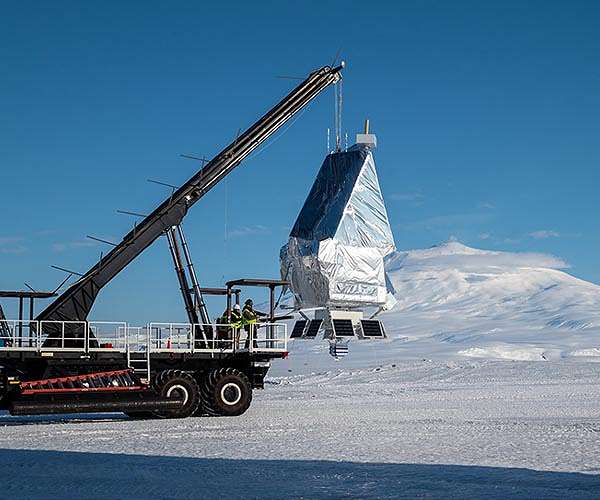
A team of scientists including physicist Johanna Nagy at Washington University in St. Louis successfully launched a balloon-borne experiment studying the early universe on Dec. 21. The instrument, called SPIDER, was carried aloft by a scientific balloon from its launch pad in Antarctica. Nagy, an assistant professor of physics in Arts and Sciences, is one of a team of scientists who will use the SPIDER instrument to look for a pattern, or polarization, in the earliest light we can measure. This statistically unique fingerprint would be produced by interactions with gravitational waves that could be traced back to the beginning of the universe. The SPIDER project is led by researchers at the University of Illinois at Urbana-Champaign. "By searching for a particular polarization pattern in the cosmic microwave background - one that flips in a mirror - SPIDER will tell us about the universe when it was much less than one second old," Nagy said. Nagy, a faculty fellow of the McDonnell Center for the Space Sciences, and her graduate student Jared May built many new items for SPIDER in her laboratory at Washington University. The team has prepared for a three-week flight at an altitude of roughly 110,000 feet above Antarctica. At this height, SPIDER will be collecting measurements above 99.5% of Earth's atmosphere.
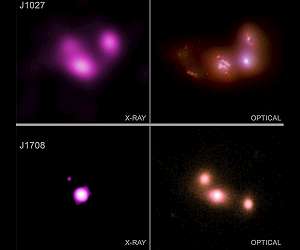
Black hole collisions could help us measure how fast the universe is expanding Chicago IL (SPX) Aug 23, 2022 A black hole is usually where information goes to disappear-but scientists may have found a trick to use its last moments to tell us about the history of the universe. In a new study, two University of Chicago astrophysicists laid out a method for how to use pairs of colliding black holes to measure how fast our universe is expanding-and thus understand how the universe evolved, what it is made out of, and where it's going. In particular, the scientists think the new technique, which they call a " ... read more
|
|||||||||||||
| The content herein, unless otherwise known to be public domain, are Copyright 1995-2026 - SpaceDaily. All websites are published in Australia and are solely subject to Australian law and governed by Fair Use principals for news reporting and research purposes. By using our websites you consent to cookie based advertising. If you do not agree with this then you must stop using the websites from May 25, 2018. Privacy Statement. Additional information can be found here at About Us. |

 del.icio.us
 Digg
Digg Reddit
 Google







