|
 |
 |
 |
 |
 |
 |
 |
 |
 |

| . |  |
. |
Rutgers Scientist Sees Evidence Of "Onions" In Space
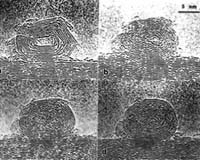
New Brunswick - Apr 30, 2003 Scientists may have peeled away another layer of mystery about materials floating in deep space. Tiny multilayered balls called "carbon onions," produced in laboratory studies, appear to have the same light-absorption characteristics as dust particles in the regions between the stars. "It's the strongest evidence yet that cosmic dust has a multilayered onionlike carbon structure," said Manish Chhowalla, assistant professor of ceramic and materials engineering at Rutgers, The State University of New Jersey. Chhowalla used transmission electron microscopes to study radiation absorption of the laboratory-produced onions and found characteristics virtually identical to those reported by astrophysicists studying dust in deep space. A carbon onion is a miniscule but intricate component of nanotechnology - the study of structures and devices on a scale that can approach one-millionth the width of a human hair. Discovered in 1992, carbon onions were considered difficult to produce in the laboratory until 2001 when Chhowalla, then at Cambridge University in the U.K., was part of a group that discovered a way to synthesize sizable quantities of the nanoparticles in water. "There had been some really good calculations that showed carbon onions are most likely responsible for the way light is absorbed by dust in space," said Chhowalla. "Being able to produce large quantities of carbon onions is what made our latest research possible." Chhowalla worked on the project with scientists from Cambridge University, Himeji Institute of Technology in Japan and Hanyang University in South Korea. Their findings are reported in a study called "Carbon Onions: Carriers of the 217.5 nm Interstellar Absorption Feature" published in the April 18 edition of the journal Physical Review Letters. Chhowalla, whose work at Rutgers is funded by a nanotechnology grant from the New Jersey Commission on Higher Education, said work with carbon onions will have practical applications besides just verifying the likely composition of cosmic dust. "There will be many uses related to nanotechnology," he said. "Carbon onions can be used in energy storage and fuel cells. We can also envision them as immensely tiny ball bearings that may be used in nanomachines built on the scale of molecules." Related Links Department of Ceramic and Materials Engineering At Rutgers SpaceDaily Search SpaceDaily Subscribe To SpaceDaily Express
 In Search Of Sol's Heart Of Nanodiamonds
 Livermore - Jul 12, 2002
An astrophysicist from Lawrence Livermore National Laboratory's Institute for Geophysics and Planetary Physics has found that some nanodiamonds, the most famous and exotic form of stardust, may instead have formed within the inner solar system. |
|
|

| The content herein, unless otherwise known to be public domain, are Copyright 1995-2006 - SpaceDaily.AFP and UPI Wire Stories are copyright Agence France-Presse and United Press International. ESA PortalReports are copyright European Space Agency. All NASA sourced material is public domain. Additionalcopyrights may apply in whole or part to other bona fide parties. Advertising does not imply endorsement,agreement or approval of any opinions, statements or information provided by SpaceDaily on any Web page published or hosted by SpaceDaily. Privacy Statement |