|
 |
 |
 |
 |
 |
 |
 |
 |
 |

| . |  |
. |
In Search Of Sol's Heart Of Nanodiamonds
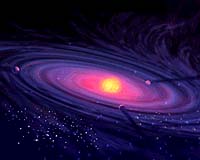
Livermore - Jul 12, 2002 An astrophysicist from Lawrence Livermore National Laboratory's Institute for Geophysics and Planetary Physics has found that some nanodiamonds, the most famous and exotic form of stardust, may instead have formed within the inner solar system. The findings argue with the wide held belief that nanodiamonds recovered from meteorites from the asteroid belt have been the most abundant type of presolar stardust grain. IGPP Director John Bradley, in conjunction with scientists from the Georgia Institute of Technology, the University of Washington, NASA Goddard Space Flight Center and the Natural History Museum in London, report their discovery in today's edition of Nature. "We presumed that if we studied (micro) meteorites (also known as interplanetary dust particles) from comets further out in our solar system, we would find more nanodiamonds," Bradley said. "But we're just not seeing them. One theory is that some, perhaps most, nanodiamonds formed within the inner solar system and are not presolar at all." Interplanetary dust particles are collected in the stratosphere using NASA ER2 aircraft and they are made up of irregularly shaped grains of carbon and/or silicates. One origin of stardust is from supernovae, the cataclysmic deaths of a star. For more than 30 years, astrophysicists have looked to stardust, a sort of remnant of stars, to tell the story of our solar system's origins. But Bradley and the group of researchers report that at least some of the oldest cometary interplanetary dust particles contain little or no nanodiamond stardust at all. "This raises all sorts of questions about the origins of our solar system," Bradley said. "Our findings are consistent with recent research that has detected nanodiamonds within the accretion discs of other young stars that are similar to our early solar system." The group concludes that an alternative explanation for the lack of nanondiamonds in the early meteorites is that all meteoritic nanodiamonds are presolar, but that their abundance decreases the further they are from the sun. In that case, our understanding of large-scale transport and circulation within the early solar system is incomplete. Related Links Lawrence Livermore National Laboratory SpaceDaily Search SpaceDaily Subscribe To SpaceDaily Express
 Scientists Produce Long, Hair-Like Nanotubes
 Troy - May 07, 2002
For the first time, researchers have created a simplified method for making long, continuous, hair-like strands of carbon nanotubes that are as much as eight inches in length. |
|
|

| The content herein, unless otherwise known to be public domain, are Copyright 1995-2006 - SpaceDaily.AFP and UPI Wire Stories are copyright Agence France-Presse and United Press International. ESA PortalReports are copyright European Space Agency. All NASA sourced material is public domain. Additionalcopyrights may apply in whole or part to other bona fide parties. Advertising does not imply endorsement,agreement or approval of any opinions, statements or information provided by SpaceDaily on any Web page published or hosted by SpaceDaily. Privacy Statement |