| . |  |
. |
| . | |
. |


 by Ed Adamczyk Washington DC (UPI) Nov 13, 2020
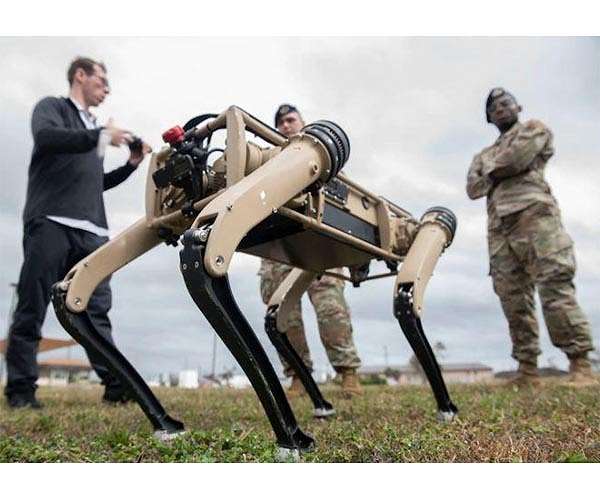
New autonomous ground vehicles, demonstrated this week at Tyndall Air Force Base, Fla., are computerized, four-legged robot dogs useable for security patrols, the Air Force said this week. The Philadelphia-based technology company Ghost Robotics worked with the base's 325th Security Squadron for a year to develop the system of autonomous machines, which were revealed on Nov. 10 in an on-base event. The robots, which walk on four legs and resemble dog's bodies, will be assigned patrol paths, enhancing patrols on the base. The robots are not intended to replace military working dogs, officials said. "We are very excited," said Maj. Jordan Criss, 325th Security Forces Squadron commander. "We are the first unit within the Department of Defense to use this technology for enhanced security patrolling operations." "These robot dogs will be used as a force multiplier for enhanced situational awareness by patrolling areas that aren't desirable for human beings and vehicles." Criss said. The robot dogs carry cameras, but not weapons. "These dogs will be an extra set of eyes and ears while computing large amounts of data at strategic locations throughout Tyndall Air Force Base," Criss added. "They will be a huge enhancement for our defenders and allow flexibility in the posting and response of our personnel." Prototype robot dogs were seen in September at an Advanced Battle Management System exercise at Nellis Air Force Base, Nev. The 321st Contingency Response Squadron security team used the robots in to secure an airfield after the arrival of airmen for the exercise "Our defenders employed the robot dogs," said Master Sgt. Lee Boston, 321st CRS loadmaster and the CR team chief for the exercise. "The dogs give us visuals of the area, all while keeping our defenders closer to the aircraft."

Robotic AI learns to be spontaneous Tokyo, Japan (SPX) Nov 12, 2020 Autonomous functions for robots, such as spontaneity, are highly sought after. Many control mechanisms for autonomous robots are inspired by the functions of animals, including humans. Roboticists often design robot behaviors using predefined modules and control methodologies, which makes them task-specific, limiting their flexibility. Researchers offer an alternative machine learning-based method for designing spontaneous behaviors by capitalizing on complex temporal patterns, like neural activit ... read more
|
|||||||||||||
| The content herein, unless otherwise known to be public domain, are Copyright 1995-2026 - SpaceDaily. All websites are published in Australia and are solely subject to Australian law and governed by Fair Use principals for news reporting and research purposes. By using our websites you consent to cookie based advertising. If you do not agree with this then you must stop using the websites from May 25, 2018. Privacy Statement. Additional information can be found here at About Us. |

 del.icio.us
 Digg
Digg Reddit
 Google







