| . |  |
. |
| . | |
. |


 by Linda B. Glaser Ithaca NY (SPX) Nov 30, 2018
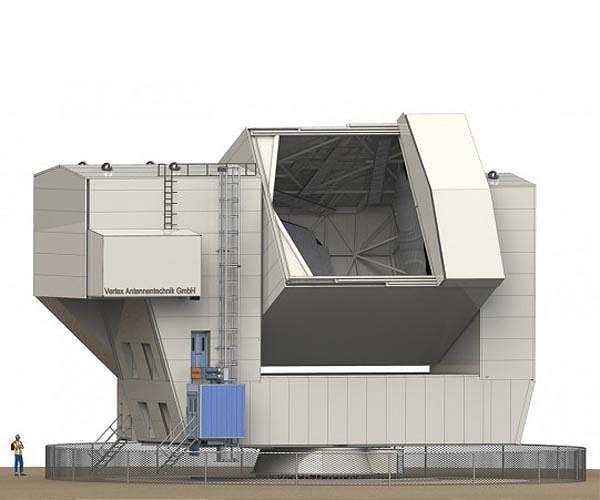
Fabrication of the Cerro Chajnantor Atacama Telescope-prime, a powerful telescope capable of mapping the sky at submillimeter and millimeter wavelengths, has now begun, marking a major milestone in the project. The 6-meter aperture telescope will be installed near the top of Cerro Chajnantor, a peak in Chile's Atacama Desert. CCAT-p will provide insights into "cosmic dawn" - when the first stars were born after the Big Bang - as well as how stars and galaxies form and the dark-energy-driven expansion of the universe. The telescope's novel optical design, high-precision mirrors and high-altitude location (over 18,000 feet) will give scientists important new opportunities for astrophysics and cosmology research. Vertex Antennentechnik GmbH of Duisburg, Germany, is fabricating the telescope's components. The design review process took nearly two years, and some of the parts will take nearly as long to fabricate, such as the telescope's two mirrors, said project director Terry Herter, professor and chair of Cornell University's Department of Astronomy. Once the fabrication is complete, the parts will be assembled at a location in Europe and functional tests will be performed on the complete structure. The telescope will then be broken down and transported to Chile in 2020, where it will be reassembled and installed on a concrete base on Cerro Chajnantor. "This project has been in development for a long time, and it's exciting to see it so close to becoming a reality," said Martha Haynes, CCAT Observatory board chair and Cornell's Goldwin Smith Professor of Astronomy. "With the short time frame for construction, we should have the telescope on top of the mountain and collecting data in a little more than two years." That moment - what astronomers call "first light" - is on schedule to take place in the middle of 2021.
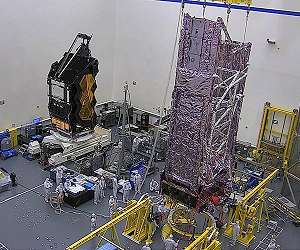
NASA's Webb Takes a Carriage Ride to Testing Chambers Greenbelt MD (SPX) Nov 28, 2018 NASA's James Webb Space Telescope is both large and heavy, so it requires some big equipment to move it from one place to another during testing. The sunshield on the Webb telescope is 70 feet by 48 feet, or roughly the size of a tennis court. Once it and the attached spacecraft bus are combined with the telescope element, with its mirrors and science instruments, Webb will weigh almost 14,000 pounds, which is about as much as a full-size school bus. In this photo, taken at Northrop Grumman ... read more
|
|||||||||||||
| The content herein, unless otherwise known to be public domain, are Copyright 1995-2026 - SpaceDaily. All websites are published in Australia and are solely subject to Australian law and governed by Fair Use principals for news reporting and research purposes. By using our websites you consent to cookie based advertising. If you do not agree with this then you must stop using the websites from May 25, 2018. Privacy Statement. Additional information can be found here at About Us. |

 del.icio.us
 Digg
Digg Reddit
 Google







