|
 |
 |
 |
 |
 |
 |
 |
 |
 |

| . |  |
. |
 by Staff Writers Paris (ESA) Jul 17, 2020
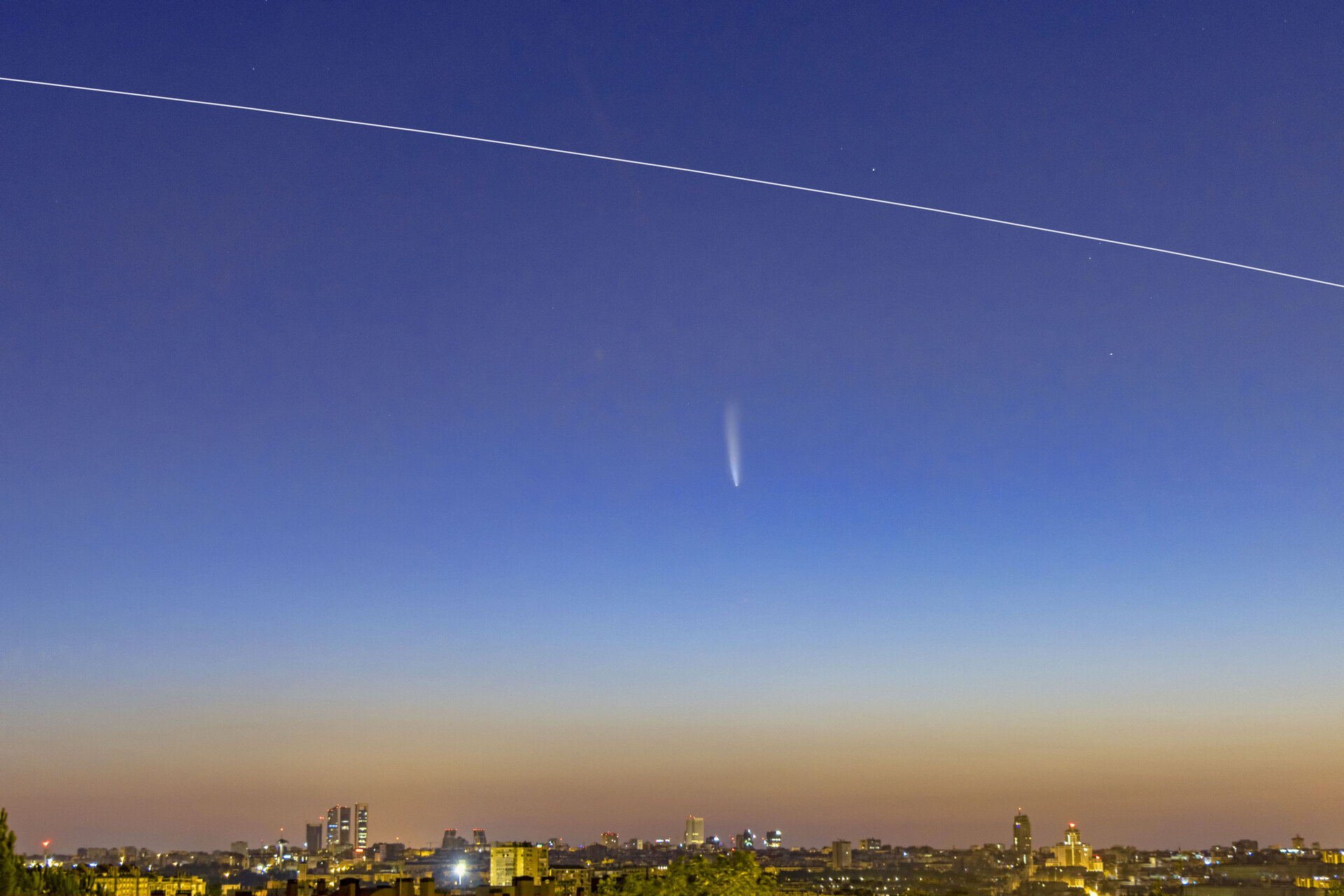
Skygazers across the Northern Hemisphere are being treated to stunning views of comet NEOWISE as it streaks past Earth. Amateur astrophotographer Javier Manteca got a bonus: the International Space Station and the comet are both seen transiting Madrid in this photo captured 11 July. Taken at dawn, the picture is a composition of 17 stacked images exposed every 2.5 seconds to form the skyline. Comet C/2020 F3 NEOWISE is named after NASA's Near-Earth Object Wide-field Infrared Survey Explorer mission that discovered it in March 2020. The comet completed its perihelion, or closest pass of the Sun, on 3 July and is headed back out of our Solar System, not to return for another 6800 years. Comets are the icy remnants from the formation of the planets 4.6 billion years ago, prompting scientists to think of them as cosmic time capsules. Comets have distinctive tails caused by dust grains being swept away from the comet's nucleus. The comet's flyby of Earth is a rare opportunity to observe and collect data on these cosmic time capsules. Many spacecraft have observed the comet, including the ESA/NASA Solar and Heliospheric Observatory as well as astronauts on board the International Space Station. ESA's comet chaser Rosetta trailed comet 67P/Churyumov-Gerasimenko for two years before landing the Philae probe on its surface. The mission amassed a wealth of data that will be studied for years to come. As comet NEOWISE zooms past Earth at a comfortable (and safe) distance of 103 million kilometres, stargazers can catch more views of the comet through July. Consult Earth and Sky or Astronomy Now for times and positions.

Parker Solar Probe spies Comet NEOWISE Greenbelt MD (SPX) Jul 13, 2020 NASA's Parker Solar Probe was at the right place at the right time to capture a unique view of comet NEOWISE on July 5, 2020. Parker Solar Probe's position in space gave the spacecraft an unmatched view of the comet's twin tails when it was particularly active just after its closest approach to the Sun, called perihelion. The comet was discovered by NASA's Near-Earth Object Wide-field Infrared Survey Explorer, or NEOWISE, on March 27. Since then, the comet - called comet C/2020 F3 NEOWISE and nick ... read more
|
|||||||||||||
|
|
| The content herein, unless otherwise known to be public domain, are Copyright 1995-2024 - Space Media Network. All websites are published in Australia and are solely subject to Australian law and governed by Fair Use principals for news reporting and research purposes. AFP, UPI and IANS news wire stories are copyright Agence France-Presse, United Press International and Indo-Asia News Service. ESA news reports are copyright European Space Agency. All NASA sourced material is public domain. Additional copyrights may apply in whole or part to other bona fide parties. All articles labeled "by Staff Writers" include reports supplied to Space Media Network by industry news wires, PR agencies, corporate press officers and the like. Such articles are individually curated and edited by Space Media Network staff on the basis of the report's information value to our industry and professional readership. Advertising does not imply endorsement, agreement or approval of any opinions, statements or information provided by Space Media Network on any Web page published or hosted by Space Media Network. General Data Protection Regulation (GDPR) Statement Our advertisers use various cookies and the like to deliver the best ad banner available at one time. All network advertising suppliers have GDPR policies (Legitimate Interest) that conform with EU regulations for data collection. By using our websites you consent to cookie based advertising. If you do not agree with this then you must stop using the websites from May 25, 2018. Privacy Statement. Additional information can be found here at About Us. |


 del.icio.us
 Digg
Digg Reddit
 Google