| . |  |
. |
| . | |
. |


 by Staff Writers Paris (ESA) Jul 30, 2019
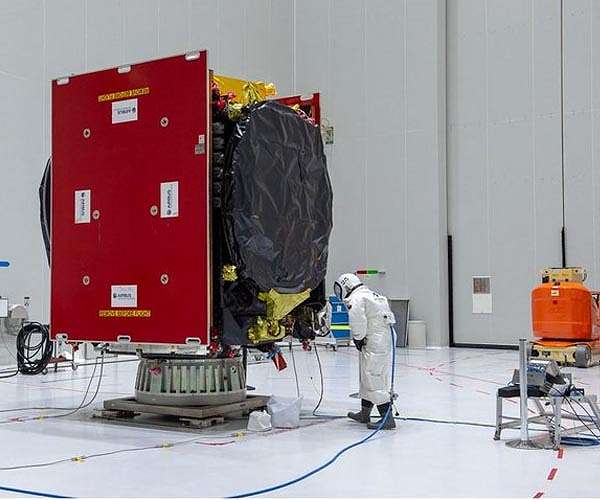
The second satellite to join the constellation that forms the European Data Relay System (EDRS) has finished fuelling and is days away from launch. EDRS uses innovative laser technology to dramatically cut the time needed for Earth observation satellites to deliver information to the ground. It enables people to observe the Earth almost live, accelerating responses to emergency situations and spurring the development of new services and products, thereby creating jobs and prosperity. The second satellite - called EDRS-C - has now been fuelled with a propellant and an oxidiser. These will be ignited after the satellite has left its Ariane 5 launcher in the low-Earth orbit phase of the launch and will enable it to climb to its final, geostationary position some 36,000 kilometres above the Earth. The leftover fuel will be used to maintain the satellite in its correct position during its expected 15-year lifetime. EDRS is a new, independent European satellite system, and is a public-private partnership between ESA and Airbus as part of ESA's efforts to federate industry around large-scale programmes, stimulating technology developments and achieving economic benefits. "Now that the satellite is fuelled, we are a step closer to placing it onto the Ariane 5 launcher and finalising it for launch," says Michael Witting, EDRS project manager at the European Space Agency.
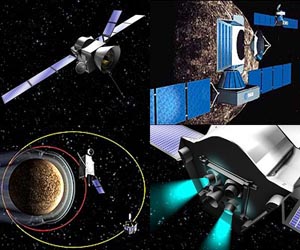
Space agencies come together Paris (ESA) Jun 17, 2019 On 14 June, President Hiroshi Yamakawa of JAXA was welcomed at the 282nd meeting of the ESA Council - the Agency's governing body - held at ESA's Operations Centre in Darmstadt, Germany. For decades, the European Space Agency and the Japan Aerospace Exploration Agency, JAXA, have worked in close collaboration to better understand our Universe. From Earth observation missions to spacecraft exploring Martian moons, Mercury or distant asteroids, ESA and JAXA continue to show how international c ... read more
|
|||||||||||||
| The content herein, unless otherwise known to be public domain, are Copyright 1995-2026 - SpaceDaily. All websites are published in Australia and are solely subject to Australian law and governed by Fair Use principals for news reporting and research purposes. By using our websites you consent to cookie based advertising. If you do not agree with this then you must stop using the websites from May 25, 2018. Privacy Statement. Additional information can be found here at About Us. |

 del.icio.us
 Digg
Digg Reddit
 Google






