| . |  |
. |
| . | |
. |


New Science Aboard The ISS
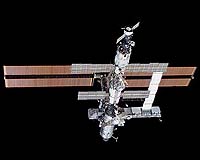
Houston TX (SPX) Aug 23, 2004 The International Space Station (ISS) crew focussed last week on the new equipment and supplies that arrived the previous Saturday aboard a Russian cargo spacecraft. Expedition 9 Commander Gennady Padalka and NASA ISS Science Officer Mike Fincke unloaded most of the two-and-a-half tons of cargo, then shifted their attention to cataloguing and stowing the material using the Station's computerized, bar code-based Inventory Management System. The ISS Progress (15) docked to the aft port of the Zvezda Service Module at 1:01 a.m. EDT Saturday (August 14), bringing fuel, water, oxygen, air, spare parts and other supplies. Other activities for the crew during the week included a reboost of the Station, moving the Station's robotic arm into position for an upcoming spacewalk and continuing science experiments. On Tuesday (August 17), Padalka and Fincke installed a new system in the Progress craft that allows the crew to command Progress thruster firings from the Zvezda module. The thruster control system was tested and then used in a reboost last Thursday (August 19) that raised the Station's altitude by about three statute miles. The ISS is now in an orbit with a high point of 228.7 miles and a low point of 215.5 miles. Another Station reboost is scheduled this week to prepare for the October arrival of a Soyuz spacecraft that will bring a new crew to the outpost. Last Thursday, the crew spent about an hour moving the Station's Canadarm2 into position for its cameras to view the upcoming spacewalk, scheduled for September 3. During the spacewalk, the crew will use Russian Orlan spacesuits and the Russian airlock to install additional navigation equipment in preparation for next year's maiden flight of the European Automated Transfer Vehicle supply spacecraft. A press briefing on the spacewalk, the fourth and final outside excursion planned during Expedition 9's stay on the Station, will be held at 2 p.m. EDT Aug. 27 at NASA's Johnson Space Center, Houston. The briefing will be carried live on NASA Television. Fincke will spend some time this week continuing to troubleshoot US spacesuit cooling system problems. New US spacesuit cooling system pumps were among the spare parts delivered aboard the new Progress two weekends ago. Science activities in the last week included biomedical crew observations and tests, among them a look at bioelectrical activity of the heart and audiograms and work on a Russian plant growth experiment. Fincke also conducted another imaging session of the Binary Colloidal Alloy Test-3 (BCAT-3) experiment. He took a total of 157 photos documenting the formation of particle suspensions in homogenized liquids. Possible future applications of the colloidal alloy experiments are photonic crystals for telecommunications and computer applications and extremely low threshold lasers, as well as improved use of supercritical fluids for food extractions, pharmaceuticals, dry cleaning, and rocket propellants. Both Fincke and Padalka conducted a session with the Educational Payload Operations by demonstrating a musical instrument called a chicken shake. Crewmembers showed how microgravity affects the egg-shaped percussion instrument that is very similar to Cuban Maracas without the handles. In Caribbean or South American orchestras, chicken shakes are used in the percussion section to add to its variety of rhythms, textures and tone colors. The sessions were videotaped and downlinked for later use by the Maryland Science Center in educator workshops designed to educate hearing impaired students about sound and the physics of sound. Related Links ISS at NASA SpaceDaily Search SpaceDaily Subscribe To SpaceDaily Express
 It's A Bird, It's A Planet...
 Moffett Field CA (SPX) Aug 23, 2004
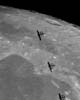
Have humans ever engineered an eclipse? The month of June featured a rare celestial reminder that eclipses are not just about our moon blocking the Sun. The first Venus transit of the Sun in over a century (since 1882) was watched around the world. When viewed from a terrestrial vantage point, the solar crossing of Venus dimmed our star. |
|
|

| The content herein, unless otherwise known to be public domain, are Copyright 1995-2006 - SpaceDaily.AFP and UPI Wire Stories are copyright Agence France-Presse and United Press International. ESA PortalReports are copyright European Space Agency. All NASA sourced material is public domain. Additionalcopyrights may apply in whole or part to other bona fide parties. Advertising does not imply endorsement,agreement or approval of any opinions, statements or information provided by SpaceDaily on any Web page published or hosted by SpaceDaily. Privacy Statement |