| . |  |
. |
| . | |
. |


It's A Bird, It's A Planet...
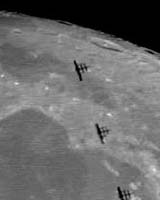
Moffett Field CA (SPX) Aug 23, 2004 Have humans ever engineered an eclipse? The month of June featured a rare celestial reminder that eclipses are not just about our moon blocking the Sun. The first Venus transit of the Sun in over a century (since 1882) was watched around the world. When viewed from a terrestrial vantage point, the solar crossing of Venus dimmed our star. To highlight curiousity in what might underpin such an eclipse, the search engine, Google, ranked the popularity of the Venus transit as topping its query list for the entire month. A year earlier, the more common Mercury transit became news. Transits of the sun by Mercury and transits of Jupiter by Jupiter's moons are observed frequently from Earth. Technically, any transit of a solar body between the Earth and Sun is termed an eclipse and only by apparent happenstance does our Moon's diameter exactly cover the solar disk. A transit can only occur when Earth and the eclipsing object are not only in direct conjunction with the Sun, but when the object also crosses at the same time through the Earth-Sun plane. Predicting an eclipse is not only about timing but also about solving a three-dimensional alignment problem. Can a satellite of the Earth- other than the Moon itself- cause an eclipse? If the eclipse is caused by humans, does the question itself strike at the premise behind a host of superstitions and omens about the cursed effects of eclipses? The ancient Jewish Talmud (Sukkah 29a) declares: "An eclipse of the sun is a bad omen for the world." The word 'eclipse' itself comes from a Greek word meaning "abandonment." In the great ancient civilizations of India, China and the Mediterranean, an eclipse was seen quite literally as the Sun abandoning the Earth. Columbus, while stranded in Jamaica with hostile locals and a mutiny of his sailors, used astronomical tables to extort supplies. The night before a predicted eclipse on September 14-15, 1494, Columbus scared the locals into providing supplies after he correctly foretold that the following night the Sun would be blocked. Even skeptics of such claims must acknowledge that solar eclipses induce a strange shift in perspective. In the shadow of a total eclipse, birds go silent and stop singing. Bees stop buzzing. Shadow temperatures fall noticeably. The weather forecast for the day can change temporarily. So what can be said about an eclipse caused by the International Space Station (ISS)? Tracking elements for the space station are well-known based on the station's approximately 90 minute orbit around the Earth. ISS moves across the sky at a fast speed familiar to those who watch airplane contrails; timing the station's fleeting appearance overhead requires mathematical skill and a good watch since the mammoth structure completely traverses from horizon to horizon in five minutes. Since the station is viewable regularly from the ground as it passes overhead, it should follow naturally that the space station must eventually cross the paths of other familiar objects like the Sun or Moon. A year and half old software project called ISS-Transit offers a method to predict the ISS crossing of the moon or Sun. This tracking might be compared to predicting the first human-induced eclipses. Among the many superlatives that have been mentioned about the scale of the International Space Station (ISS), a less often heard one is that ISS was mistaken for a planet. The comparison is not valid in scale, but dramatically alters one's perspective because of the station's altitude only 220 miles (354 km) overhead and its angular sweep large enough to transit the Sun and moon. The phenomenon is a human-made eclipse, not just a consequence of one astronaut or telescope owner raising a thumb to block a star. What's the difference? One answer has to do with scale and location. The space station is more like the Venus transit than a lunar eclipse. The size of both Venus and ISS are just blips when passing across the solar face and nowhere near large enough for a dramatic total eclipse. But on May 11th, 2004, the scale of space station was brought into relief. Just as our Moon is right-sized to blot out the Sun (based on the lunar distance and disc diameter), so too is the scale of space station right-sized to induce a total eclipse of sorts. In May, ISS presented a night view that involved a brief blotting out of the largest planet in our solar system, Jupiter. Based on the ISS diameter and relative distances, the station was able to eclipse Jupiter totally. For telescope enthusiasts, things will get even more interesting as ISS grows in dimensions. When the International Space Station is complete, it will have a mass of almost 453.6 metric tons (1 million pounds), be larger than a five-bedroom house and measure 110 meters (361 feet) end-to-end. This football-field length has prompted comparisons between ISS and natural wonders. The station is mentioned as being the largest construction project since the Egyptian Pyramids were built. At least visually, humans have begun to shape the local appearance of our solar system. However small the changes may be, an ISS transit does bear an uncanny resemblance to what in June caused all the hoopla surrounding the Venus transit. So as the space station transits across the moon or Sun, the celestial event might be said to resemble an example of our civilization's earliest attempts to engineer planetary-scale projects, ones even approaching an eclipse. Related Links ISS at NASA SpaceDaily Search SpaceDaily Subscribe To SpaceDaily Express
 New Science Aboard The ISS
 Houston TX (SPX) Aug 23, 2004
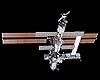
The International Space Station (ISS) crew focussed last week on the new equipment and supplies that arrived the previous Saturday aboard a Russian cargo spacecraft. |
|
|

| The content herein, unless otherwise known to be public domain, are Copyright 1995-2006 - SpaceDaily.AFP and UPI Wire Stories are copyright Agence France-Presse and United Press International. ESA PortalReports are copyright European Space Agency. All NASA sourced material is public domain. Additionalcopyrights may apply in whole or part to other bona fide parties. Advertising does not imply endorsement,agreement or approval of any opinions, statements or information provided by SpaceDaily on any Web page published or hosted by SpaceDaily. Privacy Statement |