| . |  |
. |
| . | |
. |


New Evidence Indicates Biggest Extinction Wasn't Caused By Asteroid Or Comet
Seattle WA (SPX) Jan 24, 2005 For the last three years evidence has been building that the impact of a comet or asteroid triggered the biggest mass extinction in Earth history, but new research from a team headed by a University of Washington scientist disputes that notion. In a paper published Jan. 20 by Science Express, the online version of the journal Science, the researchers say they have found no evidence for an impact at the time of "the Great Dying" 250 million years ago. Instead, their research indicates the culprit might have been atmospheric warming because of greenhouse gases triggered by erupting volcanoes. The extinction occurred at the boundary between the Permian and Triassic periods at a time when all land was concentrated in a supercontinent called Pangea. The Great Dying is considered the biggest catastrophe in the history of life on Earth, with 90 percent of all marine life and nearly three-quarters of land-based plant and animal life going extinct. "The marine extinction and the land extinction appear to be simultaneous, based on the geochemical evidence we found," said UW paleontologist Peter Ward, lead author of the paper. "Animals and plants both on land and in the sea were dying at the same time, and apparently from the same causes � too much heat and too little oxygen." The paper is to be published in the print edition of Science in a few weeks. Co-authors are Roger Buick and Geoffrey Garrison of the UW; Jennifer Botha and Roger Smith of the South African Museum; Joseph Kirschvink of the California Institute of Technology; Michael De Kock of Rand Afrikaans University in South Africa; and Douglas Erwin of the Smithsonian Institution. The Karoo Basin of South Africa has provided the most intensively studied record of Permian-Triassic vertebrate fossils. In their work, the researchers were able to use chemical, biological and magnetic evidence to correlate sedimentary layers in the Karoo to similar layers in China that previous research has tied to the marine extinction at the end of the Permian period. Evidence from the marine extinction is "eerily similar" to what the researchers found in the Karoo Basin, Ward said. Over seven years, they collected 126 reptile or amphibian skulls from a nearly 1,000-foot thick section of exposed Karoo sediment deposits from the time of the extinction. They found two patterns, one showing gradual extinction over about 10 million years leading up to the boundary between the Permian and Triassic periods, and the other for a sharp increase in extinction rate at the boundary that then lasted another 5 million years. The scientists said they found nothing in the Karoo that would indicate a body such as an asteroid hit around the time of the extinction, though they looked specifically for impact clays or material ejected from a crater left by such an impact. They contend that if there was a comet or asteroid impact, it was a minor element of the Permian extinction. Evidence from the Karoo, they said, is consistent with a mass extinction resulting from catastrophic ecosystem changes over a long time scale, not sudden changes associated with an impact. The work, funded by the National Aeronautics and Space Administration's Astrobiology Institute, the National Science Foundation and the National Research Foundation of South Africa, provides a glimpse of what can happen with long-term climate warming, Ward said. In this case, there is ample evidence that the world got much warmer over a long period because of continuous volcanic eruptions in an area known as the Siberian Traps. As volcanism warmed the planet, large stores of methane gas frozen on the ocean floor might have been released to trigger runaway greenhouse warming, Ward said. But evidence suggests that species began dying out gradually as the planet warmed until conditions reached a critical threshold beyond which most species could not survive. "It appears that atmospheric oxygen levels were dropping at this point also," he said. "If that's true, then high and intermediate elevations would have become uninhabitable. More than half the world would have been unlivable, life could only exist at the lowest elevations." He noted that the normal atmospheric oxygen level is around 21 percent, but evidence indicates that at the time of the Great Dying it dropped to about 16 percent � the equivalent of trying to breathe at the top of a 14,000-foot mountain. "I think temperatures rose to a critical point. It got hotter and hotter until it reached a critical point and everything died," Ward said. "It was a double-whammy of warmer temperatures and low oxygen, and most life couldn't deal with it." Related Links University of Washington SpaceDaily Search SpaceDaily Subscribe To SpaceDaily Express
 Anthropologists Find 4.5 Million-Year-Old Hominid Fossils In Ethiopia
 Bloomington IN (SPX) Jan 20, 2005
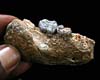
Scientists from Indiana University Bloomington and seven other institutions have unearthed skeletal fossils of a human ancestor believed to have lived about 4.5 million years ago. |
|
|

| The content herein, unless otherwise known to be public domain, are Copyright 1995-2006 - SpaceDaily.AFP and UPI Wire Stories are copyright Agence France-Presse and United Press International. ESA PortalReports are copyright European Space Agency. All NASA sourced material is public domain. Additionalcopyrights may apply in whole or part to other bona fide parties. Advertising does not imply endorsement,agreement or approval of any opinions, statements or information provided by SpaceDaily on any Web page published or hosted by SpaceDaily. Privacy Statement |