| . |  |
. |
| . | |
. |


Anthropologists Find 4.5 Million-Year-Old Hominid Fossils In Ethiopia
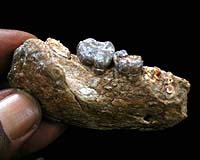
Bloomington IN (SPX) Jan 20, 2005 Scientists from Indiana University Bloomington and seven other institutions have unearthed skeletal fossils of a human ancestor believed to have lived about 4.5 million years ago. The fossils, described in this week's Nature (Jan. 20), will help scientists piece together the mysterious transformation of primitive chimp-like hominids into more human forms. The fossils were retrieved from the Gona Study Area in northern Ethiopia, only one of two sites to yield fossil remains of Ardipithecus ramidus. "A few windows are now opening in Africa to glance into the fossil evidence on the earliest hominids," said IUB paleoanthropologist Sileshi Semaw, who led the research. Semaw and colleagues also report new evidence that suggests the human ancestors lived in close quarters with a menagerie of antelope, rhinos, monkeys, giraffes and hippos in a northern Ethiopia that was far wetter than it is today. The environmental reconstructions suggest a mosaic of habitats, from woodlands to grasslands. Research is continuing at Gona to determine which habitats A. ramidus preferred. "We now have more than 30 fossils from at least nine individuals dated between 4.3 and 4.5 million years old," said Semaw, Gona Palaeoanthropological Research Project director and Stone Age Institute research scientist. The Stone Age Institute, a new research center dedicated to the study of early human evolution and culture, is affiliated with Indiana University's CRAFT, the Center for Research into the Anthropological Foundations of Technology. In their letter to Nature, Semaw and his coauthors describe parts of one upper and two lower jaw bones - with teeth still intact - several loose teeth, part of a toe bone and intact finger bones. The scientists believe the fossils belong to nine individuals of the species A. ramidus. The scientists used argon isotope dating of volcanic materials found in the vicinity of the fossils to estimate their age. In the 11 years since the naming of A. ramidus by University of California Berkeley anthropologist Tim White and colleagues, only a handful of fossils from the species have been found, and only at two sites - the Middle Awash and Gona, both in Ethiopia. Other fossils of slightly older age are known in Kenya and Chad. Anthropologists working in Ethiopia believe Ardipithecus is the first hominid genus - that is, human ancestors who lived just after a split with the lineage that produced modern chimpanzees. Despite the millions of years that separate us, modern humans have a few things in common with A. ramidus. Fossils from Gona and elsewhere suggest that the ancient hominid walked on two feet and had diamond-shaped upper canines, not the "v"-shaped ones chimps use to chomp. Outwardly, however, A. ramidus would appear a lot more chimpanzee-like than human. Gona has turned out to be a productive dig site. In a Nature cover story (Jan. 23, 1997), Semaw and colleagues reported the oldest known stone tools used by ancestral humans. The Gona artifacts showed that as early as 2.5 million years ago, hominids were remarkably skilled toolmakers. Last month (December 2004), Semaw coauthored a paper in Geological Society of America Bulletin summarizing Gona's geological properties and the site's cornucopia of hominid fossils spanning several million years. (Science magazine gave the article an "Editor's Choice" nod.) Related Links Indiana University SpaceDaily Search SpaceDaily Subscribe To SpaceDaily Express
 Officials Deny Russian Spaceport A Threat
 Moscow (UPI) Jan 13, 2005
Russia's space agency has established that space activities connected with the Baikonur cosmodrome do not impact directly on the health of nearby residents. |
|
|

| The content herein, unless otherwise known to be public domain, are Copyright 1995-2006 - SpaceDaily.AFP and UPI Wire Stories are copyright Agence France-Presse and United Press International. ESA PortalReports are copyright European Space Agency. All NASA sourced material is public domain. Additionalcopyrights may apply in whole or part to other bona fide parties. Advertising does not imply endorsement,agreement or approval of any opinions, statements or information provided by SpaceDaily on any Web page published or hosted by SpaceDaily. Privacy Statement |