24/7 Space News
CHIP TECH
Nanoscience breakthrough puts low-cost, printable electronics on the horizon
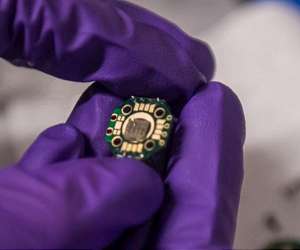
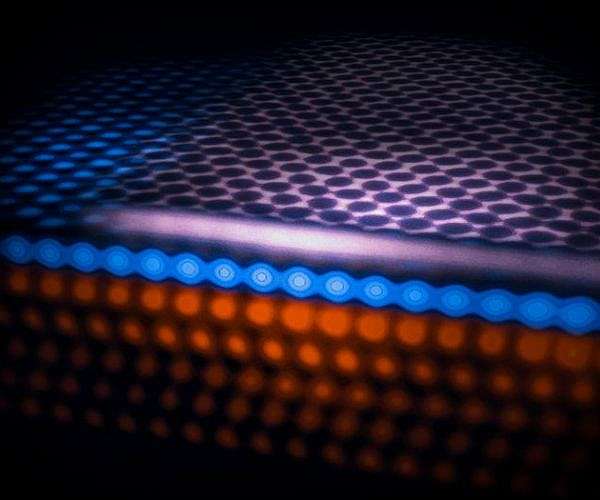
illustration only

Nanoscience breakthrough puts low-cost, printable electronics on the horizon

by Sophie Jenkins
London, UK (SPX) Dec 08, 2025

Imagine wearable health sensors, smart packaging, flexible displays, or disposable IoT controllers all manufactured like printed newspapers. The same technology could underpin communication circuits, sensors, and signal-processing components made entirely from solution-processed 2D materials.

But until now, finding and developing the 2D materials that could enable such devices was largely trial and error.

We hadn't known why some layered materials "electrochemically exfoliate" into nanosheets while others fail completely. Electrochemical exfoliation uses an electrical current to force ions into the layers of a bulk material, weakening the forces that hold them in shape, and causing the material to form thin, 2D nanosheets, if successful - some of which have myriad uses.

"Because there has never been the means to predict which materials will behave like this, and produce nanosheets with the properties we need to unlock various applications, only a handful of 2D materials have ever been processed into networks of printed 2D transistors," said Dr Tian Carey, a newly appointed Royal Society-Research Ireland Research Assistant Professor from Trinity College Dublin's School of Physics and AMBER, the Research Ireland Centre for Advanced Materials and BioEngineering Research.

"Here, we've shown that we can unlock dozens of new 2D semiconductors. We've already fabricated state-of-the-art printed transistors with over 10 new materials, unlocking new circuits for the first time. these include printed digital-to-analogue converters and BASK communication circuits, which are capable of encoding digital messages into high-frequency signals - the fundamental building blocks of modern computing."

The key seemingly lies in ensuring "in-plane stiffness" is higher than out-of-plane stiffness. This represents a measure of how resistant the material is to deformation when put under pressure from different perspectives (in-place being along the material; out-of-plane being perpendicular).

The research, led by Dr Tian Carey, in collaboration with Prof. Jonathan Coleman and colleagues, now has a predictive framework pinpointing the stiffness thresholds required for successful exfoliation across many different materials.

Using this, they created high-aspect-ratio nanosheet inks and built working transistors and circuits from them, including the first printed DACs and communication circuits.

Dr Carey added: "It's very exciting to imagine a new wave of electronic innovations, all of which could be manufactured like printed newspapers one day in the future. In theory, this approach could yield abundant low-cost, flexible, and high-performance 2D electronics."

"We now also understand from this work that each transistor's performance is limited by junctions between semiconductors rather than by defects within the semiconductors themselves, which is important in helping us direct future efforts. With this in mind, our next step will be to reduce the impact of these 'flake-to-flake' junctions to unlock the next big performance jump."

Research Report:Electronic properties and circuit applications of networks of electrochemically exfoliated 2D nanosheets

Related Links
Trinity College Dublin
Computer Chip Architecture, Technology and Manufacture
Nano Technology News From SpaceMart.com

Subscribe Free To Our Daily Newsletters
Tweet

RELATED CONTENT
The following news reports may link to other Space Media Network websites.
CHIP TECH
Quantum hardware roadmap highlights scaling hurdles on path to everyday applications
Chicago IL (SPX) Dec 05, 2025
Quantum technology is accelerating out of the lab and into the real world, and a new article in Science argues that the field now stands at a turning point - one that is similar to the early computing age that preceded the rise of the transistor and modern computing. The article, authored by scientists from University of Chicago, Stanford University, the Massachusetts Institute of Technology, the University of Innsbruck in Austria, and the Delft University of Technology in the Netherlands, offers ... read more

CHIP TECH
NASA celebrates a decade of student contributions to space crop production

Lunasa Space funding backs shared in orbit lab platform

Station 10 as Soyuz crew arrives amid Baikonur launch pad crisis

High-flying tech hits potholes in India's Silicon Valley

CHIP TECH
LandSpace ZQ 3 Y1 rocket reaches orbit on first reusable flight attempt

SyLEx test rocket gives France new suborbital launch option

South Korea advances Nuri rocket program with fourth orbital launch

AtSpace A01 reaches record suborbital altitude from Koonibba Test Range

CHIP TECH
Second CHAPEA Crew Begins Extended Mars Habitat Mission at NASA Johnson

Martian dust devils found to generate electrical sparks

NASA Orbiter Shines New Light on Long-Running Martian Mystery

ESCAPADE spacecraft capture first images while en route to Mars

CHIP TECH
China consolidates new commercial space regulator and industry roadmap

Beijing space lab targets orbital data centers for AI era

Successful launch preparations underway for Shenzhou XXII resupply mission

China launches Shenzhou-22 early for stranded space station crew

CHIP TECH
AST SpaceMobile increases US manufacturing capacity with new sites for next generation satellite production

Spire Global faces NYSE noncompliance as contract momentum collides with reporting delay

Europe secures record space budget to boost independence

UK government commits GBP 6.9 million to boost satellite communications sector

CHIP TECH
Meta shares jump on report company slashing VR spending

Exploring Easter Island Quarry Now Possible with Detailed 3D Model

Faraday Effect Reveals Magnetic Role of Light in New Study

In Data Center Alley, AI sows building boom, doubts

CHIP TECH
Machine learning tool distinguishes signs of life from non-living compounds in space samples

Moss spores withstand long term exposure outside space station

Water production on exoplanets revealed by pressure experiments

Exoplanet map initiative earns NASA support for University of Iowa physicist

CHIP TECH
Looking inside icy moons

Saturn moon mission planning shifts to flower constellation theory

Could these wacky warm Jupiters help astronomers solve the planet formation puzzle?

Out-of-this-world ice geysers on Saturn's Enceladus

Subscribe Free To Our Daily Newsletters


The content herein, unless otherwise known to be public domain, are Copyright 1995-2024 - Space Media Network. All websites are published in Australia and are solely subject to Australian law and governed by Fair Use principals for news reporting and research purposes. AFP, UPI and IANS news wire stories are copyright Agence France-Presse, United Press International and Indo-Asia News Service. ESA news reports are copyright European Space Agency. All NASA sourced material is public domain. Additional copyrights may apply in whole or part to other bona fide parties. All articles labeled "by Staff Writers" include reports supplied to Space Media Network by industry news wires, PR agencies, corporate press officers and the like. Such articles are individually curated and edited by Space Media Network staff on the basis of the report's information value to our industry and professional readership. Advertising does not imply endorsement, agreement or approval of any opinions, statements or information provided by Space Media Network on any Web page published or hosted by Space Media Network. General Data Protection Regulation (GDPR) Statement Our advertisers use various cookies and the like to deliver the best ad banner available at one time. All network advertising suppliers have GDPR policies (Legitimate Interest) that conform with EU regulations for data collection. By using our websites you consent to cookie based advertising. If you do not agree with this then you must stop using the websites from May 25, 2018. Privacy Statement. Additional information can be found here at About Us.