|
 |
 |
 |
 |
 |
 |
 |
 |
 |

| . |  |
. |
NASA's "RATS" Tests Technologies For Tomorrow's Treks
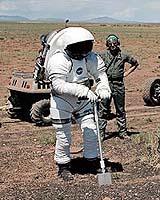
Flagstaff AZ (SPX) Sep 08, 2005 Rust-colored sand sifts through gloved hands as he slips the soil into a pouch - a travel souvenir. Standing, the suited explorer recharges his air tank, looks across the rocky landscape and imagines colonization on distant lands. Before climbing into a two-seated buggy, he studies the map his route planner plotted. Bound for the next steep slope, he treks across the barren, rugged terrain, dipping and bumping along the way. This scene, scripted from the high desert of Arizona, may one day become the real-life drama in space as humans first inhabit Mars. On Mars, humans will need the help of various technologies that permit them to venture across stretches of the red planet. Gathering clues of its past and present for its potential future with humans will depend on mobility. For the eighth consecutive season, NASA's Desert Research and Technology Studies (RATS) team has taken over the dry, dusty desert land of Arizona to torment some of the latest vehicles and gear to better understand just what it takes to be mobile. Arizona's high desert is far from Mars, but not too far off. Though it lies about 200 million miles away from the red planet, its red, rocky surface and harsh climate comes closest to Mars on Earth. "NASA's future involves returning to the Moon and then human exploration of Mars," said Joe Kosmo of NASA's Johnson Space Center, who will lead the team. "Field work will be the basic method of operation on these planetary surfaces. Field testing prepares and provides a high-fidelity hands-on experience base for engineers and scientists to better design and operate the emerging technologies for planetary surface systems." First time desert trials will put to the test two space-suited explorers, a new Science Crew Operations and Utility Testbed (SCOUT) rover and a system to recharge air tanks while they're in use. The 10-day trials are set to begin Sept. 6 in selected remote areas near Flagstaff, Arizona. The Desert RATS team includes engineers and scientists from JSC and NASA's Glenn and Ames Research Centers in cooperation with experts from Oceaneering Sea and Space Systems, Hamilton Sundstrand, ILC/Dover, Carnegie Institute, University Space Research Association and Virginia Commonwealth University. Engineers and scientists will work side-by-side in the desert with robots on tasks supported by a variety of advanced space suit prototypes, field assistant vehicle and science equipment. Long-distance support and coordination will be provided by the Mission Operations Exploration Planning and Operations Center (ExPOC) in Houston. Desert RATS team members won't be the only ones learning from the desert. Students across the country also will tap into the arid region. Through satellite-link webcasts brought by NASA's Digital Learning Network, they will learn about what it will take to send humans to Mars. Related Links SpaceDaily Search SpaceDaily Subscribe To SpaceDaily Express
 Camera's Trip To Mars Is No Leisure Cruise For Hirise Team
 Tucson AZ (SPX) Sep 08, 2005
The High-Resolution Imaging Science Experiment (HiRISE) camera is rocketing toward Mars, and it's no leisure cruise for the camera operations team at The University of Arizona campus in Tucson either. The team turned the HiRISE camera on Friday, September 2. |
|
|

| The content herein, unless otherwise known to be public domain, are Copyright 1995-2006 - SpaceDaily.AFP and UPI Wire Stories are copyright Agence France-Presse and United Press International. ESA PortalReports are copyright European Space Agency. All NASA sourced material is public domain. Additionalcopyrights may apply in whole or part to other bona fide parties. Advertising does not imply endorsement,agreement or approval of any opinions, statements or information provided by SpaceDaily on any Web page published or hosted by SpaceDaily. Privacy Statement |