
 |
 |
 |
 |
 |
 |
 |
 |
 |
 |

| . |  |
. |
Camera's Trip To Mars Is No Leisure Cruise For Hirise Team
Tucson AZ (SPX) Sep 08, 2005 The High-Resolution Imaging Science Experiment (HiRISE) camera is rocketing toward Mars, and it's no leisure cruise for the camera operations team at The University of Arizona campus in Tucson either. The team turned the HiRISE camera on Friday, September 2. NASA launched the Mars Reconnaissance Orbiter (MRO) and its science payload, which includes the HiRISE camera, on Aug. 12. HiRISE - the largest telescopic camera sent beyond Earth's orbit - and five other MRO instruments will inspect the red planet in unprecedented detail and assist future landers. The spacecraft will travel more than four times the distance to Mars before entering Mars' orbit on March 10, 2006. For the next year, the HiRISE team in Tucson will train new members joining the project, write volumes of new software, image celestial objects to check how their camera operates post-launch, and practice as if their camera already were in orbit. UA Professor Alfred S. McEwen leads HiRISE. "We're very excited, and we're working very hard," said Eric Eliason, who manages the HiRISE Operations Center (HiROC) at the UA's Lunar and Planetary Laboratory. Eliason and the rest of the HiROC team is responsible for most of the ground data system work for the HiRISE camera. Observation planning, uplink, downlink, instrument monitoring, and data processing and analysis will all be done at HiROC, which is located in the UA's C.P. Sonett Space Sciences Building. "We got our first images September 8 as the spacecraft slew our camera over the moon and then over Omega Centauri," Eliason said. "The spacecraft is flying so fast that the moon already looked very small - fewer than 200 pixels across. But we got some really pretty pictures of Omega Centauri. We're quickly seeing how well our instrument is working." Plans are for HiRISE to make other sets of star observations on Oct. 4 - 5, Nov. 5 and Dec. 13 - 14. The October images will show very precisely how MRO navigation cameras are aligned with HiRISE. The November images will help the HiRISE team fine-tune their camera's focus to get the sharpest images possible. The December images will show how vibrations from different spacecraft instruments may affect HiRISE images. "These observations will also help us to characterize the optical distortion of our lens, and what processing methods we'll need to correct for whatever distortion we see," Eliason said. The 145-pound (65 kg) HiRISE camera features a 20-inch (half-meter) primary mirror. Developed by Ball Aerospace & Technologies Corp., Boulder, Co., the $40 million HiRISE camera will take ultra-sharp photographs over 3.5-mile (6 kilometer) swaths of the martian landscape, resolving rocks and other geologic features as small as 40 inches (one meter) across. It will take pictures in stereo and color while it flies at more than 7,800 mph (3 and 1/2 km per second) about 190 miles (300 km) above Mars' surface. After entering Mars's orbit in March 2006, the MRO will gradually adjust its elliptical orbit to a circular orbit by aerobraking, a technique that creates drag using the friction of careful dips into the planet's upper atmosphere. The spacecraft's 25-month primary science phase begins in November 2006. The HiROC team expects to process 1,000 gigantic high-resolution images and 9,000 smaller high-resolution images during the science phase of the MRO mission. The MRO mission is managed by JPL, a division of the California Institute of Technology, Pasadena, for the NASA Science Mission Directorate. Lockheed Martin Space Systems, Denver, prime contractor for the project, built the spacecraft. Related Links SpaceDaily Search SpaceDaily Subscribe To SpaceDaily Express
 NASA's "RATS" Tests Technologies For Tomorrow's Treks
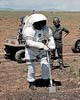 Flagstaff AZ (SPX) Sep 08, 2005
Rust-colored sand sifts through gloved hands as he slips the soil into a pouch - a travel souvenir. Standing, the suited explorer recharges his air tank, looks across the rocky landscape and imagines colonization on distant lands. |
|
|

| The content herein, unless otherwise known to be public domain, are Copyright 1995-2006 - SpaceDaily.AFP and UPI Wire Stories are copyright Agence France-Presse and United Press International. ESA PortalReports are copyright European Space Agency. All NASA sourced material is public domain. Additionalcopyrights may apply in whole or part to other bona fide parties. Advertising does not imply endorsement,agreement or approval of any opinions, statements or information provided by SpaceDaily on any Web page published or hosted by SpaceDaily. Privacy Statement |

