| . |  |
. |
| . | |
. |


NASA Develops New Portable Fuel Cell Technology
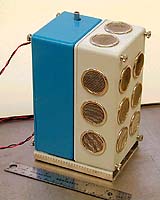
Pasadena (JPL) Apr 22, 2002 NASA researchers have reached an important milestone in developing a portable energy source that may someday give that hot pink, shades-wearing, drum-beating bunny a run for its money. A team of fuel cell experts at NASA's Jet Propulsion Laboratory, Pasadena, Calif., has taken what have been traditionally large, bulky stacks of layered fuel cells and altered their design dramatically. They have designed a compact, flat fuel cell, reducing its weight substantially. The result is a portable fuel cell technology that may someday operate small, portable electronic devices, such as cell phones, laptops, handheld organizers and camcorders, for hours and even days at a time without recharging or using expensive, heavy batteries. "This is a significant advance in fuel cell development because by going small, you make the fuel cell portable and viable for use as a power source to operate small appliances that require long operating time, such as a laptop," said Dr. S. R. Narayanan, fuel cell technical team lead at JPL. Work on the portable fuel cell technology is sponsored by a public company, TechSys, Inc., Florham Park, N.J., through a technology affiliates agreement with JPL. By becoming a technology affiliate member, TechSys, Inc., gained access to JPL engineers and technologists who specialize in fuel cell technology development. A major advantage of fuel cells over rechargeable batteries is that they can operate for longer periods of time without recharging or interruption. "Instead of recharging your laptop every two hours, imagine being able to use it for ten hours at a time," said Narayanan. Unlike batteries, these fuel cells can be recharged almost instantaneously by refueling with liquid methanol. Batteries contain toxic materials and must be disposed of properly. A fuel cell works on the same principle as a battery but is continually fed with fuel. In this new power source, methanol is put in on one side of the unit while air circulates on the other side. Both are circulated past electrodes and converted to electricity. This process produces no toxic emissions, only carbon dioxide and water as byproducts. Methanol, better known as methyl alcohol, is a common, inexpensive chemical used, for example, in windshield washer fluid. Existing fuel cells typically operate at high temperatures, require bulky thermal insulation and use hydrogen as their energy source. Much of their weight and size is due to the bipolar plates needed to connect several cells to form a stack. JPL researchers have eliminated bipolar plates and created what's called a monopolar pack, which is flat with the cells linked by electrical interconnects. To demonstrate the feasibility of the portable fuel cell technology, JPL developed a 5-watt portable power unit. The power source uses the new lightweight monopolar flat pack technology and is roughly the size of two paperback books standing tall, back-to-back. It operates efficiently at ambient temperature without a fan, unlike conventional designs. JPL engineers rigged a cell phone to this power unit and placed several phone calls as a demonstration. They estimate that the 5-watts could simultaneously power five cell phones. The system could be refueled instantly to extend the talk-time as long as needed. Now that the concept of making a portable, flat stack has been demonstrated, the next phase underway at JPL is to make it smaller, more robust and user-friendly. JPL's fuel cell group has been working on direct methanol fuel cells since the early 1990s and is credited with inventing the technology, largely under funding from the U.S. Defense Advanced Research Projects Agency. The creation of the portable power source builds on that work and experience. TechSys, Inc., has the rights to an exclusive license on the development of this micro direct methanol fuel cell technology from JPL's parent institution, the California Institute of Technology, also in Pasadena. TechSys, Inc., intends to commercialize the JPL portable fuel cell technology for civil and defense applications. Through JPL's Technology Affiliates Program, large and small businesses can work with JPL engineers to transfer technologies for commercial use. The program is just one of several JPL technology transfer programs designed to bring the benefits of the space program to American industry. Related Links JPL TecSys at Yahoo Finance SpaceDaily Search SpaceDaily Subscribe To SpaceDaily Express
 Getting Power From The Moon
 Washington - Apr 21, 2002
If a physicist in Houston has his way you'll be able to say good-bye to pollution-causing energy production from fossil fuels. In the April/May issue of The Industrial Physicist Dr. David Criswell suggests that the Earth could be getting all of the electricity it needs using solar cells -- on the moon. |
|
|

| The content herein, unless otherwise known to be public domain, are Copyright 1995-2006 - SpaceDaily.AFP and UPI Wire Stories are copyright Agence France-Presse and United Press International. ESA PortalReports are copyright European Space Agency. All NASA sourced material is public domain. Additionalcopyrights may apply in whole or part to other bona fide parties. Advertising does not imply endorsement,agreement or approval of any opinions, statements or information provided by SpaceDaily on any Web page published or hosted by SpaceDaily. Privacy Statement |