| . |  |
. |
| . | |
. |


Getting Power From The Moon
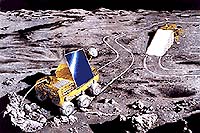
Washington - Apr 21, 2002 If a physicist in Houston has his way you'll be able to say good-bye to pollution-causing energy production from fossil fuels. In the April/May issue of The Industrial Physicist Dr. David Criswell suggests that the Earth could be getting all of the electricity it needs using solar cells -- on the moon. In the article Criswell proposes a Lunar Solar Power (LSP) System, using arrays of solar cells on the lunar surface to beam energy back to Earth. Criswell estimates that the 10 billion people living on Earth in 2050 will require 20 Terrawatts (TW) of power. The Moon receives 13,000 TW of power from the sun. Criswell suggests that harnessing just 1% of the solar power and directing it toward Earth could replace fossil fuel power plants on Earth. "The lunar operations are primarily industrial engineering," says Criswell. He and Dr, Robert Waldron first described LSP in 1984 at a NASA symposium on Lunar Bases and Space Activities in the 21st Century. "Adequate knowledge of the moon and practical technologies have been available since the late 1970's to collect this power and beam it to Earth. The system can be built on the moon from lunar materials and operated on the moon and on Earth using existing technologies," reducing the expenses associated with transporting materials to the moon. He adds that LSP would be even cheaper if parts of the production machinery are designed to be made of lunar materials. The LSP system consists of 20-40 lunar power bases, situated on the eastern and western edges of the moon, as seen from Earth. Each power base has a series of solar cells to collect energy from the sun, which is sent over buried electric wires to microwave generators that convert the solar electricity to microwaves. The generators then send the energy to screens that reflect the microwave beams toward Earth, where they are received by arrays of special antennas strategically placed about the globe. "Each antenna converts the microwave power to electricity that is fed into the local power grid," says Criswell. "LSP is probably the only option for powering a prosperous world within the 21st century," says Criswell. "However, it does require a return to the moon." The system depends on some human occupation of the moon to build and run the lunar bases, but Criswell also sees this as an opportunity. "Once we are back and operating at large scale then going down the various learning curves will make traveling to the moon and working there 'routine.' " Related Links Full Article PDF file (305KB) American Institute of Physics SpaceDaily Search SpaceDaily Subscribe To SpaceDaily Express
 Ultra clean transportation fuels by deep desulfurization
 Washington - Apr 12, 2002
A process that removes organic sulfur from liquid fuels at low temperatures and ambient pressure without using hydrogen, may help refiners provide fuels for fuel cells and meet the upcoming government's ultra-clean fuel requirements, according to Penn State researchers. |
|
|

| The content herein, unless otherwise known to be public domain, are Copyright 1995-2006 - SpaceDaily.AFP and UPI Wire Stories are copyright Agence France-Presse and United Press International. ESA PortalReports are copyright European Space Agency. All NASA sourced material is public domain. Additionalcopyrights may apply in whole or part to other bona fide parties. Advertising does not imply endorsement,agreement or approval of any opinions, statements or information provided by SpaceDaily on any Web page published or hosted by SpaceDaily. Privacy Statement |