


. 24/7 Space News .
MOST Space Telescope Plays 'Hide & Seek' With An Exoplanet

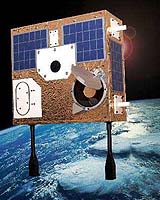
Illustration of MOST in orbit.

Montreal QC (SPX) May 17, 2005
MOST, Canada's first space telescope, has turned up an important clue about the atmosphere and cloud cover of a mysterious planet around another star, by playing a cosmic game of `hide and seek' as that planet moves behind its parent star in its orbit.

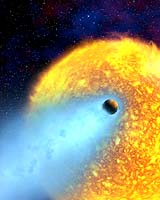
The exoplanet, with a name only an astrophysicist could love, HD209458b (orbiting the star HD209458a), cannot be seen directly in images, so the scientists on the MOST (Microvariability & Oscillations of Stars) Satellite Team have been using their space telescope to look for the dip in light when the planet disappears behind the star.

"We can now say that this puzzling planet is less reflective than the gas giant Jupiter in our own Solar System," MOST Mission Scientist Dr. Jaymie Matthews announced today at the annual meeting of the Canadian Astronomical Society in Montreal.

"This is telling us about the nature of this exoplanet's atmosphere, and even whether it has clouds."

Many of the planets discovered around other stars, known as exoplanets or extrasolar planets, hug surprisingly close to their parent stars; HD209458b orbits at only 1/20th of the Earth-Sun distance (an Astronomical Unit or AU).

It could never support life as we know it. But understanding HD209458b is a key piece in the puzzle of planet formation and evolution that is revising theories of our own Solar System, and estimates of how common are habitable worlds in our Galaxy.

How a giant ball of gas that is larger than the planet Jupiter (which orbits 5 AU from our Sun) got so close to its star, and how its atmosphere responds to the powerful radiation and gravitation fields of that star, are still open questions to exoplanetary scientists.

"The way this planet reflects light back to us from the star is sensitive to its atmospheric composition and temperature," describes Jason Rowe, a Ph.D. student at the University of British Columbia who processed the MOST data.

"HD209458b is reflecting back to us less than 1/10,000th of the total visible light coming directly from the star. That means it reflects less than 30-40% of the light it receives from its star, which already eliminates many possible models for the exoplanetary atmosphere."

By comparison, the planet Jupiter would reflect about 50% of the light in the wavelength range seen by MOST.


Related Links
University of British Columbia
Spitzer Space Observatory at Caltech
SpaceDaily
Search SpaceDaily
Subscribe To SpaceDaily Express


Memory Foam Mattress Review
Newsletters :: SpaceDaily :: SpaceWar :: TerraDaily :: Energy Daily
XML Feeds :: Space News :: Earth News :: War News :: Solar Energy News


Questioning Terrestrial Planets
Moffett Field CA (SPX) Apr 28, 2005
Maggie Turnbull, an astronomer with the Carnegie Institution, has spent many years thinking about what kind of stars could harbor Earth-like planets. Her database of potentially habitable star systems could be used as a target list for NASA's upcoming Terrestrial Planet Finder (TPF) mission.

---------------------------------------------------------
New from Telescopes.com!

It's new. And it's downright terrific!

Celestron's CPC Schmidt-Cassegrain telescope is the scope you've been waiting for! It offers new alignment technology, advanced engineering, and bold new design at a new, low price!

In fact, Celestron's Professional Computerized (CPC) scope with revolutionary SkyAlign Alignment Technology redefines everything that amateur astronomers are looking for. It offers quick and simple alignment, GPS technology, unsurpassed optical quality, ease of use, advanced ergonomics, enhanced computerization and, most important, affordability.

Want to view M-31 tonight? One button takes you there!

Shop for telescopes online at Telescopes.com! today!
------------------------------------------------------------


  • Canadian Arrow Launches New Spaceflight Venture
  • Space Launch Scraps Providing Sustenance For Russian Villagers
  • SpaceDev Dream Chaser Human Space Transport System Designed
  • AERA Announces Ticket Sales and Target Window for First Commercial Launch December 2006

  • Opportunity Turns Its Wheels
  • Progress Inch-By-Inch For Opportunity
  • Study Explains Mystery Of Mars Icecaps
  • Jumping Genes And The Red Planet

  • EADS Pulls Plug On New Bigger Version Of Ariane Rockets
  • NOAA-N Launch Delayed Until May 20
  • Russia To Launch Belorussian Satellite
  • Orbital Awarded Contract By USAF To Provide Responsive Launch Vehicles

  • NASA's CloudSat Spacecraft Arrives At Launch Site
  • NOAA Issues Its Annual Atlantic Hurricane Season Outlook
  • ISRO Scientists Present First Images Of Cartosat-1
  • Atmosphere May Cleanse Itself Better Than Previously Thought

  • Preperation For Mission To Pluto And Beyond Continues
  • Ball Aerospace Delivers Imaging Instrument For NASA's Mission To Pluto
  • Case Of Sedna's Missing Moon Solved
  • Pluto's Horizon Gets Page One Treatment At NASA.gov

  • Canadian Space Scope Detects Puzzling Brightness Variations In Dying Star
  • First-Ever Infrared Flash Challenges Notion Of Nature's Biggest Bang
  • "Wonderful" Star Reveals Its Hot Nature
  • Xmm-Newton Sees 'Hot Spots' On Neutron Stars

  • Divining For Lunar Water?
  • Prospecting For Lunar Water
  • Don't Breathe the Moondust
  • A Solar Eclipse On The Moon

  • NovAtel GPS Receivers Deployed In China Port Container Terminals
  • Cubic's GPS-Based Tracking & Positioning Data Incorporated For First Time
  • Crossing Africa With EGNOS
  • TransCore Develops New Satellite-based Trailer Tracking Sensors

  • The content herein, unless otherwise known to be public domain, are Copyright 1995-2006 - SpaceDaily.AFP and UPI Wire Stories are copyright Agence France-Presse and United Press International. ESA PortalReports are copyright European Space Agency. All NASA sourced material is public domain. Additionalcopyrights may apply in whole or part to other bona fide parties. Advertising does not imply endorsement,agreement or approval of any opinions, statements or information provided by SpaceDaily on any Web page published or hosted by SpaceDaily. Privacy Statement