|
 |
 |
 |
 |
 |
 |
 |
 |
 |

| . |  |
. |
Questioning Terrestrial Planets
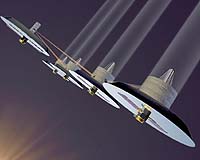
Moffett Field CA (SPX) Apr 28, 2005 Maggie Turnbull, an astronomer with the Carnegie Institution, has spent many years thinking about what kind of stars could harbor Earth-like planets. Her database of potentially habitable star systems could be used as a target list for NASA's upcoming Terrestrial Planet Finder (TPF) mission. Turnbull presented a talk, "Remote Sensing of Life and Habitable Worlds: Habstars, Earthshine and TPF," at a NASA Forum for Astrobiology Research on March 14, 2005. In this fourth and final part (see Part 1, Part 2, and Part 3)of the edited transcript, Turnbull answers questions from an audience of fellow scientists. Question (Q): The Galileo spacecraft's main camera saw Earth as only a few pixels and tried to do spectroscopy on that. Will any such observations be done by the Cassini spacecraft? Answer (A): I haven't heard anything about Cassini doing this, and now it is too late because, from Cassini's current point of view, the Earth is very close to the sun. We are looking into getting spectra of the Earth with the Messenger mission, which is en route to Mercury but will be making an Earth flyby later in the year. There are some issues with the position of the sunshade, but that satellite has a low resolution spectrograph in the optical and the near infrared. That would be perfect if they could point it at the Earth, and, I think, the next logical step in preparation for TPF. Q: Have you considered looking for biosignatures that would be characteristic of intelligent life, for instance, pollutants like CFCs that have a spectral signature in the infrared? A: I've heard it mentioned in passing, but as far as I know that idea hasn't been pursued. I think it might be a problem of detectability. I don't know the wavelengths of all the stuff that we're spewing into the atmosphere. If they're dust particles or large molecules, they may be too far to the infrared for TPF to detect. But methane is another biosignature that would be of interest, especially for younger planets. Methane on our planet today does to some extent reflect the presence of humans. But methane is hard to disentangle from geological activity, as we're now finding out with the detection of methane on Mars. Q: Is there a maximum size for a terrestrial planet? How much does that detection envelope expand as you consider larger rocky planets? A: No one really knows if you can make a rocky giant planet - we have no analogue for this in our solar system. As far as we know, the maximum size of a terrestrial planet is somewhere between one and ten Earth masses, or between the mass of the Earth and the mass of Neptune. As a planet gets larger, the fractional planet brightness goes up. So TPF will have a much easier time detecting larger terrestrial or giant gaseous planets, but we still want to mostly try to detect planets that are Earth-sized. Q: How narrowly do we define something as being Earth-like? For large fractions of the Earth's history, the planet has been glaciated. The optical absorption in a forest is much greater than for the Earth as a whole, since oceans and glaciers have a different signature. So if you had a glaciated Earth or a heavily watered Earth, TPF could miss it completely. You could still see the oxygen signature, but that brings up another issue: on Earth there are something like 20 different bacterial metabolic pathways. One happened to win the fight. Other photosynthetic pathways include Rhodopsin, a purple bacteria that has a different optical spectrum than chlorophyll. So what would a Rhodopsin World look like? That world would still be Earth-like, except for the fact that we couldn't live there.

|