|
 |
 |
 |
 |
 |
 |
 |
 |
 |

| . |  |
. |
Scientists Produce Long, Hair-Like Nanotubes
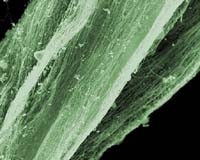
Troy - May 07, 2002 For the first time, researchers have created a simplified method for making long, continuous, hair-like strands of carbon nanotubes that are as much as eight inches in length. This breakthrough, reported in the May 3 issue of Science, is a first step toward creating such products as microcables for electrical devices or mechanically robust electrochemical actuators for artificial muscles. The researchers from Rensselaer Polytechnic Institute and collaborators at Tsinghua University in Beijing found that chemical vapor deposition (CVD), a widely used technique to grow nanotubes, has a high yield of long strands when a sulfur-containing compound and hydrogen are added to the process. Researchers have previously created nanotube fibers with more complex methods, but because CVD is commonly used to make nanotubes, it would be easily adaptable and more efficient for synthesizing the long strands for practical applications. This new method produced nanotubes that measured 20 centimeters, much longer than conventional nanotubes, said Pulickel Ajayan. "Carbon nanotubes are generally microns in length, which is not long enough for any practical purpose," said Ajayan, associate professor of materials science at Rensselaer Polytechnic Institute in Troy, N.Y. "We have created strands with nearly aligned nanotubes that are as long as 20 centimeters. The nanotubes are well ordered in these structures and are self-assembled during the growth process, which means we don't end up with an unusable lump that looks like cooked spaghetti," he added. The process could also be an easier alternative to creating high-purity single-walled nanotube material in general, said Bingqing Wei, a post doctoral associate of Ajayan's who came to Rensselaer from Tsinghua University. Related Links Rensselaer Polytechnic Institute SpaceDaily Search SpaceDaily Subscribe To SpaceDaily Express
 Addition Of Fluorine Opens Door To Hundreds Of Nanotube Derivatives
 Houston - Apr 16, 2002
Researchers at Rice University say fluorine -- the most reactive element in nature -- could prove to be a key in unlocking the potential of carbon nanotubes and other carbon nanostructures. |
|
|

| The content herein, unless otherwise known to be public domain, are Copyright 1995-2006 - SpaceDaily.AFP and UPI Wire Stories are copyright Agence France-Presse and United Press International. ESA PortalReports are copyright European Space Agency. All NASA sourced material is public domain. Additionalcopyrights may apply in whole or part to other bona fide parties. Advertising does not imply endorsement,agreement or approval of any opinions, statements or information provided by SpaceDaily on any Web page published or hosted by SpaceDaily. Privacy Statement |