| . |  |
. |
| . | |
. |


 by Staff Writers Greenbelt MD (SPX) Aug 09, 2016
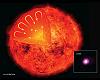
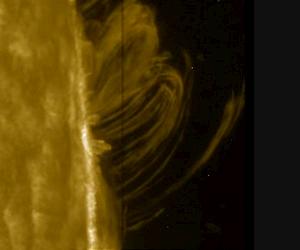
NASA's Interface Region Imaging Spectrograph, or IRIS, captured a mid-level solar flare: a sudden flash of bright light on the solar limb - the horizon of the sun - as seen at the beginning of this video. Solar flares are powerful explosions of radiation. During flares, a large amount of magnetic energy is released, heating the sun's atmosphere and releasing energized particles out into space. Observing flares such as this helps the IRIS mission study how solar material and energy move throughout the sun's lower atmosphere, so we can better understand what drives the constant changes we can see on our sun. As the video continues, solar material cascades down to the solar surface in great loops, a flare-driven event called post-flare loops or coronal rain. This material is plasma, a gas in which positively and negatively charged particles have separated, forming a superhot mix that follows paths guided by complex magnetic forces in the sun's atmosphere. As the plasma falls down, it rapidly cools - from millions down to a few tens of thousands of kelvins. The corona is much hotter than the sun's surface; the details of how this happens is a mystery that scientists continue to puzzle out. Bright pixels that appear at the end of the video aren't caused by the solar flare, but occur when high-energy particles bombard IRIS's charge-coupled device camera - an instrument used to detect photons.
Related Links Interface Region Imaging Spectrograph Solar Science News at SpaceDaily
|
|||||||||||||
| The content herein, unless otherwise known to be public domain, are Copyright 1995-2026 - SpaceDaily. All websites are published in Australia and are solely subject to Australian law and governed by Fair Use principals for news reporting and research purposes. By using our websites you consent to cookie based advertising. If you do not agree with this then you must stop using the websites from May 25, 2018. Privacy Statement. Additional information can be found here at About Us. |


 del.icio.us
 Digg
Digg Reddit
 Google